
As the old tradition came to an end in the first years of the 19th century, the old harpers who were the tradition bearers seem to have played harps that were made in the first half of the 18th century. Denis O’Hampsey died in 1807; his harp was made in 1702. Patrick Quin was still alive in 1811; his harp is dated 1707 though some people argue that it is much older. The last dated instrument in the old tradition I know of is the Bunworth harp, made in 1734. There are later references to harps being made; Arthur O’Neill talks about going to the harpmaker Conor O’Kelly to oversee the completion of an instrument, which would have been after about 1750. And William Carr, who was by far the youngest of that last generation of tradition bearers, mentions having a rather poor quality harp made for him by a carpenter, apparently in the late 1790s.
All of the harps we know about that were played in the continuing tradition at the end of the 18th century and into the 19th century were large, mostly high-headed instruments. We don’t actually know what kind of harps were used by the first generation of revival students taught by Arthur O’Neill in the early 19th century; but the second generation of charity school students from 1819 on played on the big wire-strung ‘hybrid’ Irish harps made for the Belfast Harp Society by John Egan. Some of these students continued playing their big ‘hybrid’ harps down to the 1880s.
Yet the wire-strung harps made for revival purposes from the 1890s onwards don’t look back to Egan’s hybrid wire-strung harps, and they don’t even look back to the 18th century harps played by the last of the tradition-bearers. Instead, the models were the medieval Trinity College harp and the Queen Mary harp.
I really noticed this in May when I was gathering images for my Discovery Day talk. The centrepiece of the talk was our current method for re-connecting to the end of the tradition, by getting a replica of Quin’s or O’Hampsey’s harp, studying posture and hand position from Quin’s or O’Hampsey’s portrait, and working through the field transcriptions of Quin’s and O’Hampsey’s playing.
But the images of revivalists from the 1890s to the 1970s all showed small medieval harps.

Equally interesting is the way these harps were used. The slide of the Glen harp is revealing, showing Kate MacDonald playing with the harp on her right shoulder, and held very high, in a classical style and technique.

The Dolmetsch harp is shown with a photo of Edith Taylor; though we know she played left-hand-treble in the old style, what I have found about her music suggests she was playing classical-style arrangements of the “songs of the Hebrides”. Mabel Dolmetsch used one of these medieval style Irish harps to play tunes from Bunting’s piano arrangements in the 1930s.
Chris Warren’s picture is especially interesting. He was explicitly working to re-connect to the end of the tradition in the 1790s and early 1800s; he worked on the “harp music in the Bunting collection”, but he used a copy of the medieval Trinity College harp.
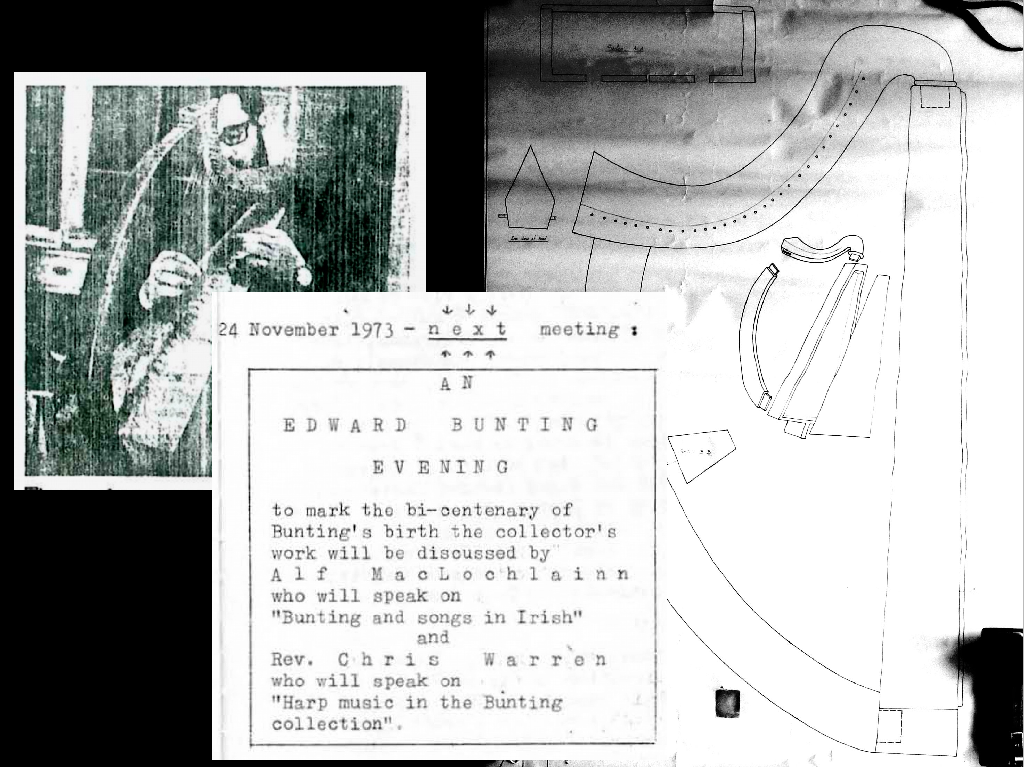
It was only with Ann Heymann in the later 1970s that we saw someone getting a copy of first Quin’s harp, and then O’Hampsey’s harp, and studying Bunting’s manuscripts with the transcriptions of the old harpers’ playing.
What is going on here? I think this is connected to the harp as symbol, vs. the harp as working instrument. The Trinity College harp as the national symbol, gave it a much stronger resonance, than the 18th century harps as the working instruments of the last tradition-bearers 200 years ago.
We need to do more research on this, to find out if anyone else was taking the big 18th century style harps seriously before Ann; and to correlate better the playing style, idiom, repertory and instrument choices of different revivalists over the past century or more.
Interesting observations,
Where would you say the dividing line is between what is appropriate to play on a medieval style harp vs. An 18th century harp? Is there a singular date or is it a stylistic theme? And how do you treat tunes that may be older than their publication date, or don’t have a date at all?
You mention dating tunes – you are right that quite a few tunes seem to be current in living tradition for many centuries. For me it is less how to treat a given tune (because obviously there are different possible ways to treat such a long-lived tune); I like to think about different general approaches.
For me, there are two different approaches; one is the historical recreationism approach, which is obviously what is in play when someone makes or plays a replica medieval musical instrument. The other approach is trying to re-connect to the broken end of the tradition; in the case of Irish harp that means looking to follow the late 18th- early 19th century tradition-bearers.
I’m not sure there is ever a definitive “dividing line” in history or cultural development, but I think that there was a big break approximately over the course of the 17th century with a fundamental shift in instrument design and musical forms generally.
In a specifically Gaelic context, there a big social and cultural discontinuities with the Cromwellian wars and the Jacobite-Williamite wars
I suppose I think of analogies with other musics or art-forms. Think of the difference between playing Mozart on a violin, and playing Trouvere songs on a medieval fiddle.
Firstly, ignore my stupid comments about the old tradition coming to an end “in the first years of the 19th century”. See my Long 19th century project for information about how it continued into the first years of the 20th century.
Secondly, there is a very interesting article by Ulrich Morgenstern which gives us some ways to think about this phenomenon. He says:
We can think here about what the Reference Culture is for “the Irish harp”. I think that the Trinity College or Brian Boru harp, as an icon of the ancient Bardic traditions, has been a central focus of the idea of the Irish harp right back to the end of the 18th century, even when the inherited living tradition was thriving. We can also wonder how much this medieval bardic Reference Culture is actually researched, and how much it is invented.
Morgenstern also discusses how
and he cites Bruno Nettl for examples of
The book seems to have only been published as an e-book; you can download the whole book or individual chapters from various sources, e,g, this chapter, on Morgenstern’s Academia page.
Ulrich Morgenstern, ‘The Role and Development of Musical Instruments in European Folk Music Revival and Revitalization Movements. Some Common Trends’, in: Jana Ambrózová, Bernard Garaj (eds), Traditional Music and Dance in Contemporary Culture(s). Nitra: Constantine the Philosopher University, 2019, pp. 10-27.
The RTÉ Archive has a superb film interview of Chris Warren, by the reporter Cathal O’Shannon, broadcast on Newsbeat on 7 October 1970
Warren plays a fragment of the tune Da mihi manum / Tabhair dom do lamh / Give me your hand on his undersized Brian Boru-based medieval wire-strung Irish harp. You can hear how he has tuned the harp to the Downhill scale, about a 4th lower than I would specify for a harp this size, at a low pitch (about A415), and strung it with very thin wires, giving it an amazingly twangy sound. He comments in the interview that he knew he was on the right track because he had heard the 1961 recording of the actual Brian Boru harp when it was restored by the British Museum, and restrung by Joan Rimmer, and played by Mary Rowland. Rimmer’s restringing and tuning was similarly under-tensioned (because of the fragility of the medieval woodwork) and the recording has a similarly twangy sound.
Warren’s motivation is clearly stated, when O’Shannon asks him why he made his little harp: “Basically, no-one really knows what the traditional Irish harp sounded like, the sort of thing Carolan and other men like him used to play”. And he continues: “well it’s not a copy of his one of course, but the design is based on the Trinity College harp which is the oldest in Europe, probably”, as if using a medieval exemplar was the obvious thing to use to explore the 18th century traditional music, rather than, say, a copy of the Carolan harp in the NMI.
Warren also pushes the end of the tradition back as far as he can; “the most recent ones that have survived are about 1700” and he doesn’t think anyone has made “anything quite like this” since then, showing a lack of awareness of other revivalists as well as of the continuation of the tradition. “the last person who could play was about 1800” he says, valourising Hempson’s long fingernails as the main marker of the tradition and ignoring Hempson’s comtemporaries and the generations of traditional harpers that followed him.
Perhaps most interestingly, he is aware of the 19th century traditional wire-strung harps in the National Museum, the ones by Egan and Hewson including the harp school Egan which I reverse-engineered for my construction drawings. “There have been attempts to make… about 120 or 30 years ago, there were a few harps made that were strung with wire, there’s one of them is in the museum in Dublin, but this was … basically a modern harp strung with wire, and it sounds altogether different”. This is quite possibly based on Joan Rimmer’s book published the previous year (The Irish harp, 1969, p67-68), where she prints a photograph of a traditional wire-strung Irish harp made by Francis Hewson in 1849 (NMI DF:1951:2), and describes “a number of these instruments survive in good condition and they can only be described as nightmare parodies of the old Irish harp. Their tone is peculiarly unattractive, rather like that of an ancient and decrepit piano, and the sound is excessively long-lasting unless damped”.
I checked back on the printed interview with Warren from a couple of years later, ‘Rediscovery of harp tradition’ by the music critic Charles Acton, published in Éire-Ireland vol VII part 4, 1972. On p125, Warren describes harps that are not made with a one-piece soundbox, mentioning the Hollybrook “said to have belonged to Carolan”, and the Clonalis Carolan harp, and “the big 18th-century harp that I found in Limerick and sold to Seán Ó Riada” (a 19th-century traditional wire-strung harp now in University College Cork). Acton asks if this means that the one-piece willow soundbox is not a defining characteristic of the traditional wire-strung harp, and says that “the brass strings on the Ó Riada harp make a magnificent sound”. Warren replies “yes but it’s a different tone. Somewhere betwixt and between, a little bit mellower than my own which has a sort of harsh clangour about it”. And Warren gets even more tangled up and confused as he continues, “there’s a sort of sweetness about the Ó Riada harp which is a little bit nearer to the ‘neo-Irish’ harp.”
I should also add a link to my old project web pages about Arnold Dolmetsch’s work, including digitised recordings of Mabel playing from the 1930s:
https://earlygaelicharp.info/Dolmetsch/