Spitzharfe
Preface
Introduction
The old instruments
Names
Stringing and setup
Playing technique
Repertory and music
Other related instruments
Appendices
Museum instruments
Source texts
Old pictures
Bibliography

Spitzharfe
Preface
Introduction
The old instruments
Names
Stringing and setup
Playing technique
Repertory and music
Other related instruments
Appendices
Museum instruments
Source texts
Old pictures
Bibliography
Arpanetta
It is clear that the spitzharfe was considered by the 18th century writers to be related not to harpsichords, nor to dulcimers and psalteries, but to harps. I assume this is because of the way it was played, and perhaps the repertory played on it. Nowadays we would disagree, and, based on its construction and set-up, we would categorise the spitzharfe as a kind of psaltery or dulcimer, having no organological relationship to harps.
There is a closely related type of instrument in use in Germany slightly earlier, known in German as Doppelharfe (double-harp). This is basically set up similarly to a spitzharfe, with a rank of strings on each side of a soundbox, 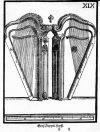 but it tends to be triangular in shape with the point at the bottom, more like a true harp, and to have the tuning pins mounted along the top instead of along the bottom. The strings are usually of gut and may have bray pins. There is a famous illustration printed by Michael Praetorious in Syntagma Musicum in 1620 (reproduced right), showing both sides of a ‘Groß Doppel Harff’. Similar instruments are preserved in museums, e.g. Museum für Musikinstrumente, Leipzig, 384 and Hessisches Landesmuseum, Darmstadt, Kg67:114.
Next: List of Museum instruments...
Simon Chadwick, St Andrews, Scotland.
June 2013