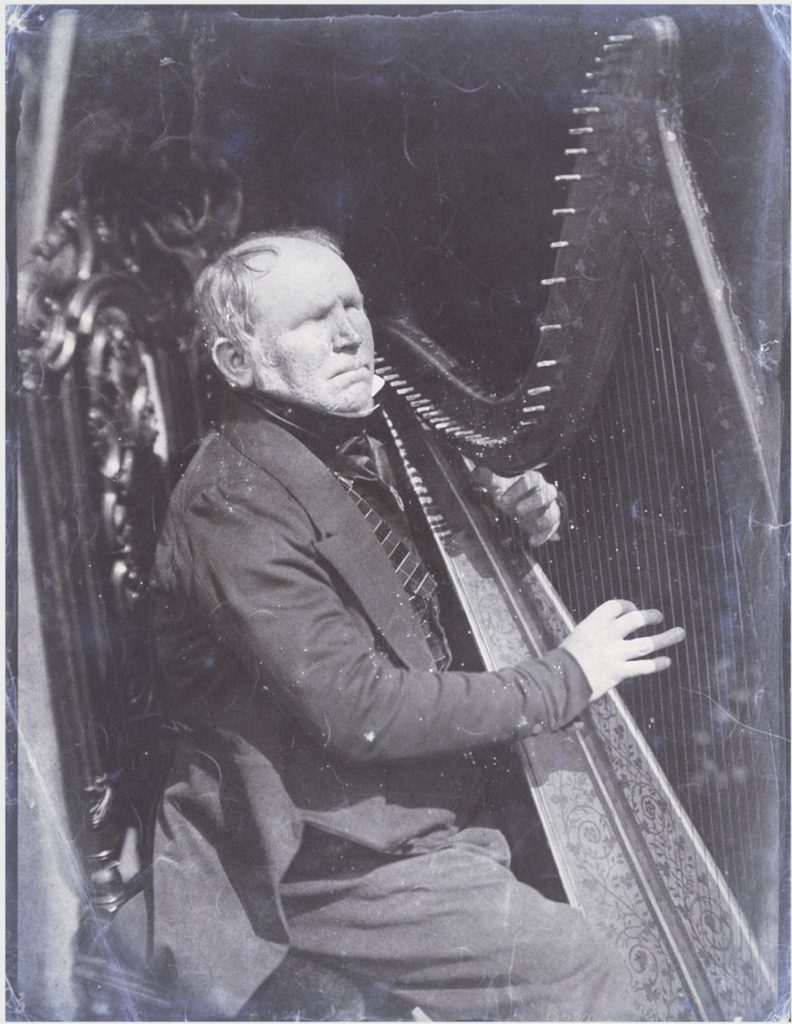
The wire-strung Irish harp is the traditional harp of Ireland. Wire-strung harps were played in Ireland (and also in Scotland) from earliest times. Medieval wire-strung harps are preserved and displayed in Dublin and Edinburgh, as national treasures.

The playing traditions of the Irish harpers were rich and complex. The method of playing and the system of music was passed down by a master formally teaching a young harper, down through the generations. This tradition is specifically Irish, and there are many differences between traditional wire-strung Irish harp, and other harp traditions from other countries. The metal strings give the Irish harp a long rich resonance and complex harmonic spectrum. The fingering techniques, all named in the Irish language, are an important part of controlling and shaping the resonance and the harmonics of the wire strings. The left hand plays the treble and the right hand plays the bass, the opposite of most other European harp traditions.
Classical pedal harps were introduced into Ireland in the 1790s, and from then on there was competition between the classical harpists, playing classical-style on gut-strung harps, and the Irish harpers playing on traditional wire-strung harps. The classical harpists soon started claiming that they were real Irish harpers. All through the 19th century and into the 20th century, the wire-strung harp tradition was marginalised and suppressed by classical musicians, including by the very people who were claiming to save it. The last few tradition-bearers died in the first decade of the 20th century, ignored, unknown, and unrecognised.
The lever harp was introduced from England in 1897, and was taught and promoted by a classical pedal harpist. The lever harp was fitted into the void left behind after the suppression of the traditional Irish harpers, but it belonged to a very different sound-world and playing style from the traditional wire-strung Irish harp. Many people in Ireland and beyond recognised that the lever harp was a new introduction from outside of Irish tradition, and they sought instead for the original wire-strung harp sound and traditions.

A number of pioneering individuals tried to make wire-strung harps, and tried to work out how to play them, but they were hindered by looking back to the iconic medieval instruments, rather than to the full-sized harps used by the last of the tradition-bearers. I think it was not until the 1970s that a few started getting hold of full-sized wire-strung harps, and Ann Heymann in particular started connecting the surviving fragments of recorded tradition to begin the long work of re-discovering a lost and suppressed playing tradition. She was my mentor and adviser from the beginning of my work in the late 1990s, and set me on my life’s work. Perhaps most importantly, she recognised the necessity of not using a classical music background or approach, but she tried to understand the wire-strung Irish harp as a traditional music, fitting into Irish traditional music norms. From the early 2000s, Siobhán Armstrong began a movement of research and discovery in Ireland, with new instruments and new work to study playing styles and repertory. And from around 2020, Sylvia Crawford finally stitched together all of these directions of research to complete a reconstructed method of playing.

(NMI DF 1913.381)
When I started trying to learn to play the traditional wire-strung Irish harp over 25 years ago, I realised that there was a rich and complex tradition, but that it was fragmented and lost. But I also realised that there was an enormous amount of information from the inherited tradition; some of the old harpers’ instruments are preserved in museums and private collections; we have lists of playing techniques, and fragmentary settings of tunes played on the traditional wire-strung Irish harp. I started searching for, cataloguing and organising this information, and I realised back then that there was an almost overwhelming amount of information about the traditional harp music, almost too much; I realised that a genuine revival and renewal of the lost tradition should be possible, but that it would require a lot of work by different people with different backgrounds and different areas of expertise.
I have focussed on studying and reconstructing the instruments to discover and define the traditional norms, most recently by drawing up plans and designs for the types of traditional wire-strung Irish harps used by the last of the tradition-bearers, and having new copies made by harp-makers. Sylvia Crawford has been intensely working to understand and interpret the lists of fingering techniques and making a structural analysis of the traditional music, to understand the harmony and resonance of these traditional instruments, and to re-build the method of playing of the traditional harpers, leading to an ongoing renewal of the tradition amongst her students and others (like me) who are following her lead.


