Miss Flinn was a young woman who played the traditional wire-strung Irish harp in Drogheda in the 1840s. This post is to try and find out more information about her.
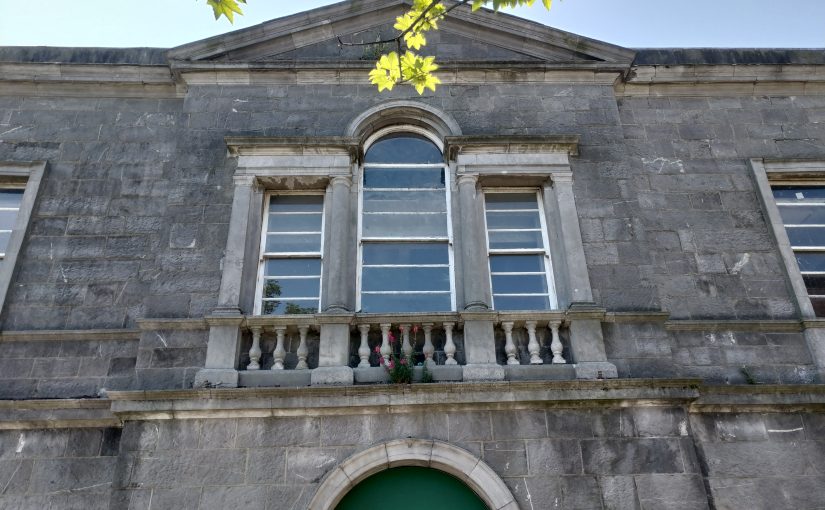
So far I have only one reference to Miss Flinn playing the harp. She is listed as one of Hugh Frazer‘s six pupils, who performed at the Drogheda Harp Society concert in the Mayoralty House on Monday 19th February 1844. I have already written about this concert, in my posts on some of the other harp students who appeared there, especially Halpin. The other performers were McEntegart, Dowdall, Branagan, O’Hagan, and Frazer. My header photo shows the upstairs room in the Mayoralty House, where the concert was held.

The concert programme was printed in two newspaper adverts, in the Drogheda Conservative Journal, Sat 17 Feb 1844 p3, and the Drogheda Argus, Sat 17 Feb 1844 p3. Both adverts contain different typos, mis-spellings and other errors; but both have the same text for Miss Flinn’s part of the programme. She is listed as performing two tunes or songs, “Love’s Young Dream”, and “The Fairy Boy”.

I think there can be no real doubt that Miss Flinn was playing these on a full-sized traditional wire-strung harp, and that she had learned the traditional way of playing from the harper and tradition-bearer Hugh Frazer at the harp school he taught in Drogheda. I wrote a lot about the harp school in my post on another of the pupils there, Peter Dowdall; how the school had been set up by Father Burke in the Dominican Priory house in the beginning of 1842, and how harps were made by a local carpenter, apparently copying the design of Hugh Fraser’s traditional wire-strung Irish harp, which was most likely by or copied from John Egan. For more on the Drogheda harps, see Nancy Hurrell’s article in History Ireland 21:1, Jan/Feb 2013.
I do not yet fully understand how Miss Flinn may have fitted in to the harp school in Drogheda. The school seems to have been run very differently from the earlier Belfast schools run by the Belfast Irish Harp Society in Pottinger’s Entry (1809-12), Cromac Street (1820 – 1838), and Talbot Street (1839-40). While the Belfast schools were non-discriminatory and equal-opportunity, and were designed to fast-track young people to becoming professional harpers, the Drogheda school seems to have been totally focussed on Catholic young boys, teaching them the harp as part of their personal and community religious and nationalistic development.

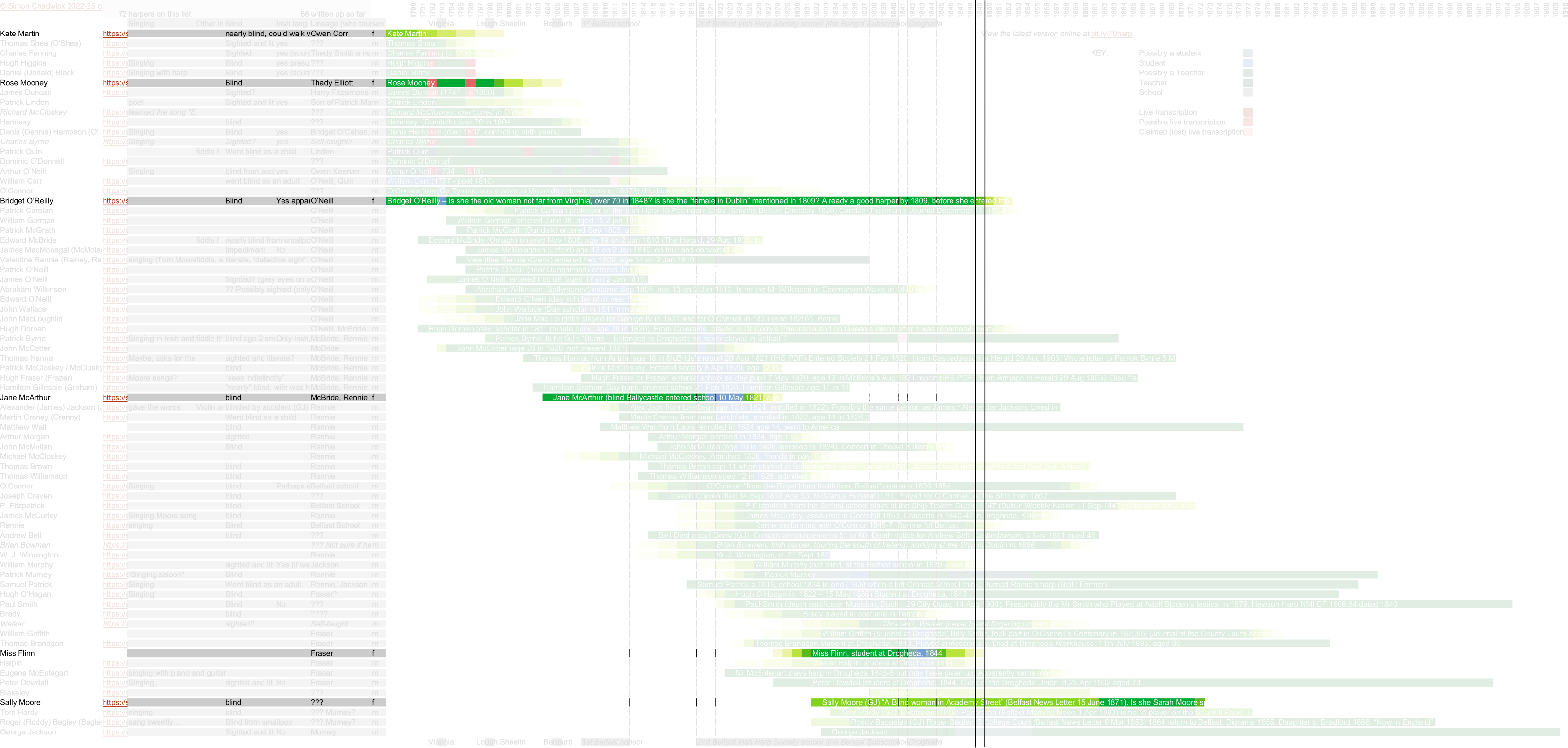
It seems to me that there was a big mismatch between the ideas of Thomas Burke, and the reality on the ground of Hugh Frazer teaching the playing techniques and training young people to actually play the traditional wire-strung Irish harp. It was very much a manly instrument. Hugh Frazer had learned under Edward McBride and Valentine Rennie at the Belfast harp school in the early 1820s, and they had both learned from Arthur O’Neill at the Belfast harp school around 1810. Despite the Belfast schools being open equally to boys and girls, I only know of one girl who attended as a pupil at the Belfast schools, Hugh Fraser’s classmate Jane MacArthur. Of all the 72 traditional harpers listed on my timeline, who were active between 1790 and 1909, only six were women. To me this suggests a self-selection, with girls much less interested in applying to the school to learn the traditional Irish harp.
Thomas Burke had a romantic notion (probably from classical music influence) that the harp was a feminine instrument; his florid speeches often reference harp playing in feminine terms. He says things like this:
… To adorn, to enhance the virtues of the daughters of Erin, by placing within the means of all the music and the accomplishment of kings, is an object of our labours, that … the notes of the harp be heard in every village blended with the voice of beauty and virtue. Daughters of green Erin of streams! “Praise ye the Lord with Psaltery and harp: let every spirit praise the Lord.” – Psl. 150. “White-handed daughter of Toscar, many a voice and many a tuneful harp was there. Of Erin’s chiefs they sang; and sometimes on the lovely sound was heard the name of the now mournful Ossian” …
First Annual Report and Address of the Committee of the Drogheda Temperance and Irish Harp Society, Order of the Golden Cross, reprinted in the Drogheda Argus, 15 Apr 1843 p1, also Nation, 15 Apr 1843 p426
We can see that Burke’s imagination bears very little relation to the reality on the ground of the full time study of the traditional techniques and method of playing the wire-strung harp. Yet we should not be too hard on poor Burke, since he did put his money where his mouth was, and hired Hugh Fraser to be the teacher, and hired Francis Flood to make full-size wire-strung harps suitable for use in the inherited tradition.
Perhaps Burke was slightly irritated that it was only boys who came to Hugh Fraser’s classes and learned to play the harp, because he said in a speech a few days later, on Easter Monday 17th April 1843, that he was hoping also to have a harp school for girls up and running within the next year:
… and ere this day twelve months I hope to have a school of young female harpists who will realise the piety and virtue of David and Ossian, and in their evenings of social and festive joy, will not be unmindful of the duties which they owe to their God and to their country (cheers). If young men feel pride and pleasure in being masters of band music, which is only for external effect and show, why should not the young females, of the same class, be equally desirous to excel in music and song, and to add a thousand charms to the domestic circle? What but the music of the harp, when all else had failed, could touch or win the soul of Ossian, so as to make him live over joys long passed? “White handed daughter of Toscar…”
Drogheda Argus, Sat 22 Apr 1843 p1, via Vivienne McKeon, ‘One Faithful Harp Shall Praise Thee’: Social and Political Motives of the Drogheda Harp Society, MA thesis, NUI Maynooth, 2005 p34
Reading his speeches, we get the impression that Burke was a fantasist, and an enabler who whipped people up into enthusiasm to do the things that his creative brain threw out, all bound up with his drive and mission of religious and national revival. The “young men” mentioned in the Easter Monday speech are not the harpers, but are members of the Temperance band. Burke had imagined having harpers back in 1841, and so the harp society had been founded in the beginning of 1842; Burke hired Frazer as a traditional harp teacher, and also he seems to have insisted that the harpers learn to play liturgical music as part of the religious revival; but apart from that I imagine that Fraser was left to get on with the business of actually teaching people to play.
So how do we place Miss Flinn in all of this? My suspicion at the moment is that Burke’s fantasy of a harp school for young girls never got off the ground, and that Hugh Fraser and his boys was all that actually happened. And therefore I presume that Miss Flinn either joined the boys, as Jane McArthur had done in Belfast in the 1820s, or that she came to Hugh Frazer separately to get classes on her own.
It is possible that society in general was getting more segregated by the 1840s. I noted when I wrote up Sally Moore, that she was the right age and place to have been learning from Pat Murney in Belfast around 1850. It seems that there were probably three boys learning from Murney at that time, George Jackson, Tom Hardy and Roger Begley, but Sally Moore is not described as if she was part of their little scene. It is possible that by the mid 19th century it was no longer so socially acceptable to have mixed schools. I don’t know enough about the rise of Victorian prudishness and sex segregation to say more. We can however see Burke has a clear idea of the boys having loud visible public roles with their band music and with the harp performances, while he imagines the girls playing the harp at home for private family and personal devotion and inspiration.
Anyway I think we have to accept that Miss Flinn did get taught to play the traditional wire-strung Irish harp by Hugh Fraser, and by February 1844 she was good enough to play two solos on the traditional wire-strung Irish harp at the public concert in the Mayoralty House in Drogheda.
The tunes
We have two titles said to have been performed by Miss Flinn at the Harp Society concert in the Mayoralty House on Monday 19th February 1844, “Love’s Young Dream”, and “The Fairy Boy”.
Love’s young dream

Love’s Young Dream (Oh the days are gone) is a song by Thomas Moore, which was published in the 4th number of his Irish Melodies in 1811. If you want to hear it being sung, you can listen to Mary O’Hara. Moore says the tune he has used for this song is called “The Old Woman”, and it looks like he got it from Edward Bunting’s 1809 book, on page 31, where it is titled “An tseann bheann bhocht / The old woman” (Una Hunt, Sources and style… p155). We don’t know where Bunting got the tune from, but variants of this tune appear in many 18th century books, and there are very many versions of the song airs sung to it. There are also different tunes with the same title. Donal O’Sullivan made a great list of them in his Bunting part V (1936) p10-20. We are not told if Miss Flinn was singing Tom Moore’s words, or just playing the traditional tune on the wire-strung Irish harp.
The Fairy Boy

The Fairy Boy is a song by Samuel Lover. Normally I am finding Lover’s songs don’t have much staying power in the tradition, but this one does. You can listen to Joe Heaney singing Lover’s words set to a different tune. There are also Irish words, under the title An Leanbh Sidhe. You can listen to Peg Clancy Power singing the Irish words, to Lover’s tune. I think we can be fairly confident that Miss Flinn was playing Lover’s tune, though she may or may not have been singing Lover’s English words.
An anonymous women harper
All that I have written so far comes from the programme list for the concert in Drogheda on Monday 19th February 1844. But there is no other mention of Miss Flinn in a harp-related context, so to say any more we are going to have to cast the net much wider, and be a lot more speculative.
One of the things I am trying to do in my Long 19th Century project is to see if I can guess the identities the various anonymous harpers who appear in newspaper reports. There is a report in the newspaper of a meeting of the Belfast Total Abstinence Society, in the Lancastrian School, Frederick Street, on Easter Monday 9th April 1849. The report adds:
The performance of a blind woman on the harp, which she played very well, added much to the pleasure of the meeting
Northern Whig Tue 10 Apr 1849 p2
We can check my timeline of traditional harpers to try and guess who this was. I think she would have been too old to be Bridget O’Reilly, but probably a bit too young to be Sally Moore. The two possibilities are Jane McArthur, and Miss Flinn. We are told that Jane McArthur was blind, and she was originally from Ballycastle and she learned the harp in Belfast in the 1820s, so perhaps she is the most likely candidate.
Though the other women active as harpers in the long 19th century were all blind or partially sighted, there is no reason whatever to think that Miss Flinn might have had any vision problems. As far as I can tell, blindness was much more associated with the Belfast harp schools, which specifically offered professional training to blind pupils. The Drogheda harp school was not focussed on this; there were two or three blind boys at the Drogheda school, who would (we are told) benefit from the professional opportunities of being trained as a harper (Drogheda Argus Sat 14 May 1842, Drogheda Argus, Sat 2 Nov 1844 p1). But the other Drogheda pupils were presumably sighted and possibly also literate, and were not being trained as professionals, even though some of them did go on to make their livings as traditional harpers.
Can we track down Miss Flinn anywhere else?
The other pupils of Hugh Fraser who we know about seem to have been aged in their late teens or early twenties at the time of the concert, and so we might cautiously think that Miss Flinn may have been born in Drogheda in the 1820s.
Birth records don’t start in Ireland until 1864. There are Catholic parish registers from before then, but they are much harder to search, and anyway neither of these sources would help us find the birth of “Miss Flinn” given that we don’t know anything else about her. Some Catholic parish marriage records do survive, but again without knowing more about her already we would not be able to find her I don’t think. The civil registers of marriages can be more useful since they can give address details and occupations, but Catholic marriages were not recorded by the civil registrars until 1864. And of course if Miss Flinn married, then without the marriage record we would not be able to find her death record, because she would be recorded under her married name. I did check for unmarried Miss Flinns in the death records but I did not see anyone who could plausibly be her. It is also possible that she emigrated, either under her maiden name or her married name. At the moment I don’t know of any sensible way to try and find more information about her. If only we had the Irish census records so that we could find her in Drogheda in 1841.
The name Flinn is much more commonly spelled Flynn, occasionally O’Flynn, and the Irish form is Ó Floinn. You can see on Barry Griffiths’s maps of Flinn and Flynn that the name does not seem to be concentrated in any particular part of Ireland.
I did find information about other musical Miss Flinns, but they all seem to be based in Dublin. The Dublin Evening Mail of Wed 23 Jun 1847 p3 reports that “Miss Flinn … has, we understand, returned to Dublin, after a lengthened absence. Report speaks highly of her as a most accomplished pianiste – a worthy pupil of Mendelssohn and Moscheles”. It appears that she had been away studying in Leipzig. But this is obviously not our Miss Flinn. James Joyce had musical great aunts, the Flynn sisters from Dublin, who were born between 1829 and 1835. I suppose it is possible that one of the older Miss Flynns from this Dublin family went up to Drogheda to join the harp school, but this seems very unlikely to me. Hugh Frazer’s pupils in Drogheda seem to have been local Drogheda people.
Another thing this all highlights is how much more difficult it is to track down the women in 19th century records. Because of how their names change when they get married, and also because of how we do not get their first names as much as we do for men, it is infuriatingly difficult to trace individual women through the different references.
Conclusion
We know that Miss Flinn learned enough from her teacher Hugh Fraser, that she could play two solo pieces in the public concert. She had the tradition; she had learned to play from Hugh Fraser, who had learned in the 1820s from Edward McBride and Valentine Rennie, who had learned in around 1810 from Arthur O’Neill, who had learned in the mid 18th century from Owen Keenan of Augher, and so on back through the inherited tradition. But I suspect she may have been more like her classmate Eugene McEntegart, in that I suspect she may have played the traditional wire-strung Irish harp only within the context of Father Burke’s religious and cultural revival scene. After Burke died at the end of 1844, the scene seems to have come to a quick end, and I suspect that Miss Flinn may have moved on in her life, and not continued to play. I think it is fairly likely that she may have just had an ordinary life, perhaps marrying and raising a family and running a household, and not really thinking much about how in her youth she had been privileged to be handed a thread of the inherited tradition.
The piper Séamus Ennis used to play ‘The Fairy Boy’, which was, he said, a favourite of his father’s. Interestingly, he played the tune in C, which gave it a very lonesome sound against the D drones, when it could easily be played in D major.