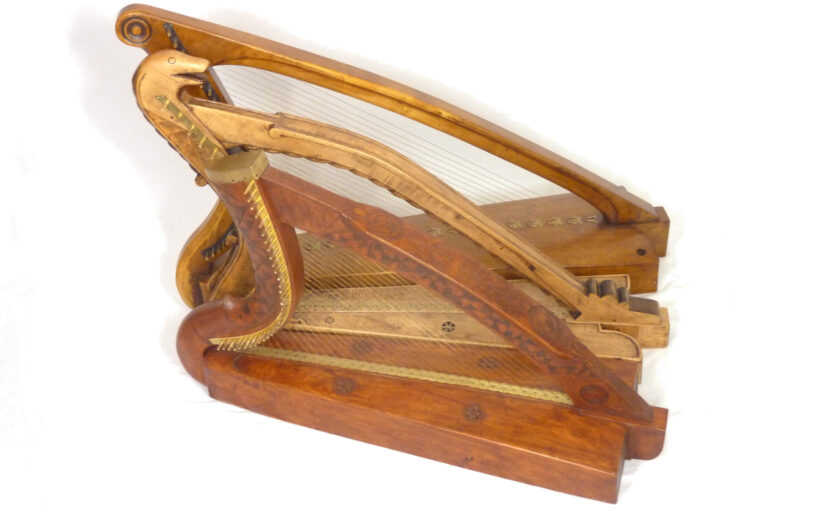
It was only in 2022 that I realised about the importance of the continuing tradition of playing wire-strung Irish harps in the inherited tradition right through into the 20th century. I got Tim Hampson to make a harp based on John Egan’s design, which was finished in 2023, and which demonstrated the superiority of Egan’s design and how it had set the standards for traditional wire-strung Irish harps for decades to come.
You can find out more about my plans for a traditional wire-strung Irish harp on my plans page.
Before 2022, all of this was unknown and disregarded, and so those of us trying to restore the inherited tradition of wire-strung Irish harp playing, were looking much further back, to earlier harpers, earlier instruments, and earlier makers.
Being that much earlier, there is much less documentation preserved, and the designs of the earlier harps are much less developed and they work less well. Each of the 18th century harps is different; each design is deficient or unsatisfactory in some way. It is almost as if every single maker and every single harp was an experiment, trying to get the traditional wire-strung Irish harp to work satisfactorily. We know that John Egan made hands-on study of some of the 18th century harps, which informed his design; and the reaction of the traditional harpers was as if Egan had solved the puzzle they had been struggling with for the previous century and a half.
There has been quite a bit of work done on these 18th century Irish harps, and a number of them have been scanned and studied, and good working copies made. I have worked with a number of good high-quality reproductions, trying to understand how they work and how they can be set up.
But I no longer recommend any of these designs for learning to play traditional wire-strung Irish harp. If you just want to play, then the best design is the Egan design.
The Downhill harp
The Downhill harp is often considered a good model to copy; it is small, easily carried, and works very well and is fairly easy to set up as a good working instrument. Also, its association with the traditional harper Dennis Hampson gives it an important cultural significance. On the other hand many people find it too small to be ergonomic and comfortable.
The Downhill harp has not been 3D scanned, and templates and data are not available. This means that any maker wanting to make a harp copying the design of the Downhill harp is on their own.
The Castle Otway harp
The Castle Otway harp is a very interesting instrument; it works like the other traditional 18th century instruments but it has a much older look or style. I think it is a less ergonomic harp, much more difficult to hold and play, and lacking in the bass range which makes it speak less well than some of the others, and makes it less usable for the traditional repertory and method of playing. I would say that its overall design is heavily compromised by its antique shape and appearance. But it has an important cultural significance because of its association with the traditional harper Patrick Quin.
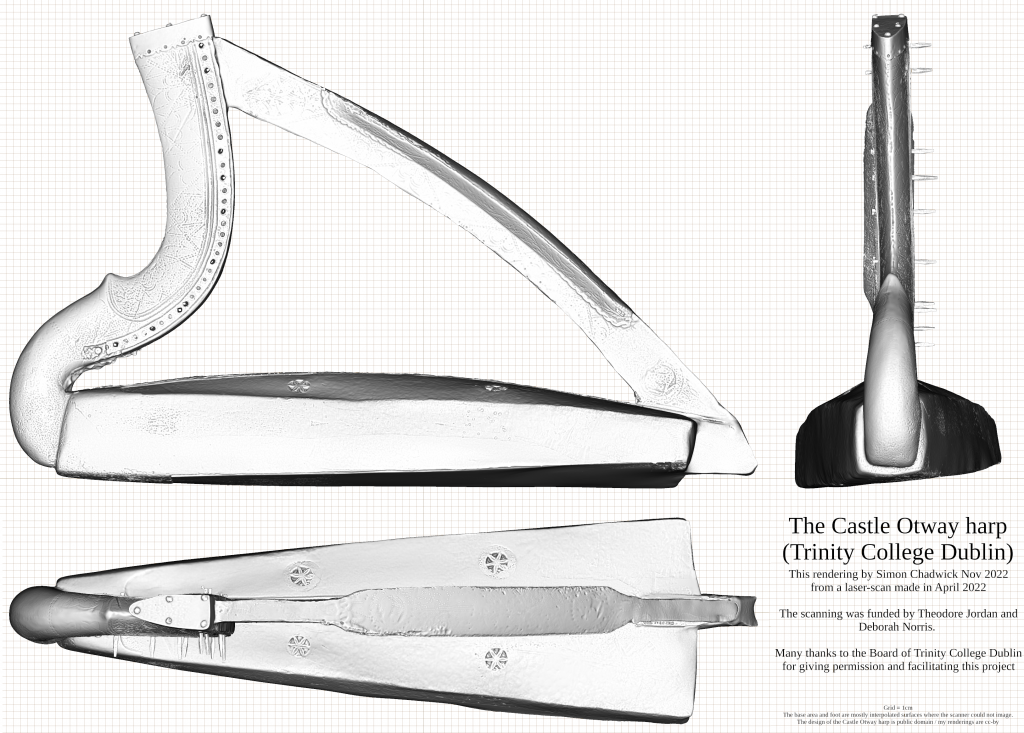
The Castle Otway harp was scanned in 2022, and I have made a set of plans and templates as a resource for harpmakers and researchers. They are all available on my Castle Otway Harp Plans page.
The Hollybrook harp
The Hollybrook harp is one of the best-documented of the 17th-18th century Irish harps. The Hollybrook harp is very handsome, and it has a good low bass range. Its construction is also less problematical for modern workshops. But it is on the small size, which compromises its sound and ergonomics.
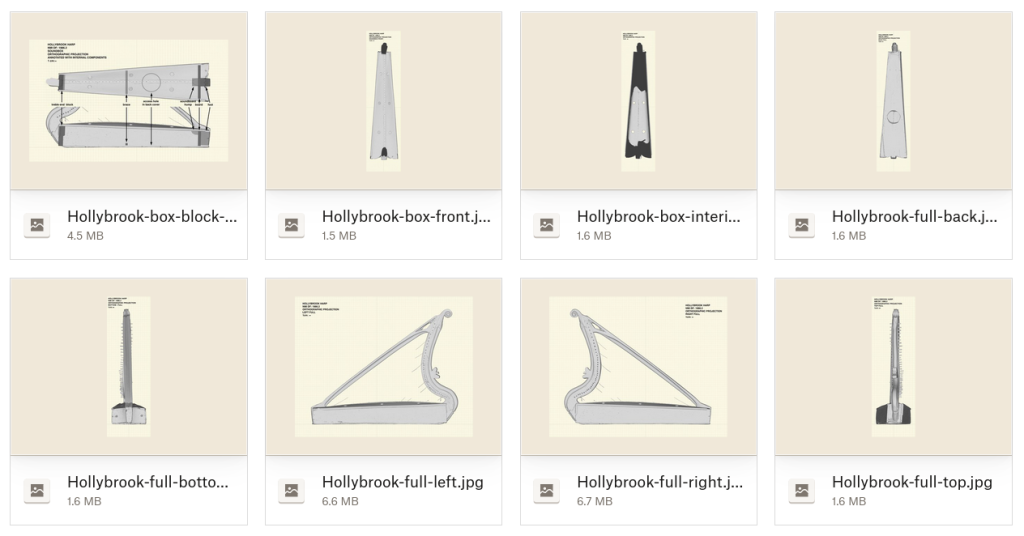
A full report on the Hollybrook harp by Karen Loomis and myself has been published on the HHSI website. The 3D scan is on Sketchfab; Karen has generated a full set of plans for the harp, and there is also a huge amount of other information and analysis about the harp and its construction, decoration etc.
The Kildare harp
Barbara Karlik is gradually publishing her data on the Kildare harp. You can download the 3D scan from Sketchfab, which is a great basis for you to generate templates, cross-sections, etc. Check her website for updates to this project. The Kildare is a big and very elaborately decorated harp.
The NMI Carolan harp
I studied the NMI Carolan harp, and wrote it up as a peer-reviewed paper: Simon Chadwick, ‘Provenance and recording of an eighteenth-century harp’, The Galpin Society Journal LXXIII, March 2020, p.85-110 & 199-201. Obviously its traditionary association with the traditional harper and composer and singer Turlough Carolan gives it great cultural significance even if that association cannot be proved at all.
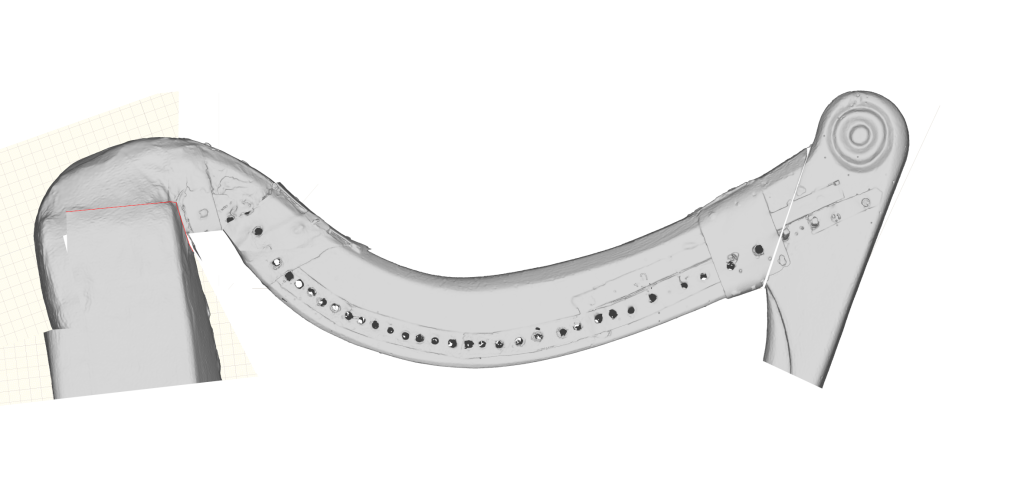
There is a 3D scan which you can view online or download, and my (unsorted) processed templates which I generated from the scan are in Dropbox. All of this material has been released on an open license so you can use it and create your own derivative works freely without restrictions. Mostly because of the damage and distortion, there are a number of issues with making a reconstruction copy of it. Get in touch if you want more information.
Other early harps
The Mulagh Mast harp has been 3D-scanned, and the scan is available to view on Sketchfab, but templates and other data are not yet available.
Robert Bruce Armstrong’s book published in 1904 has some technical information about many of these old harps. I usually have a secondhand copy available for sale. It is also available online at the Internet Archive.
Strings and stringcharts for 17th and 18th century Irish harp reconstructions
I started trying to work out stringing regimes for traditional wire-strung Irish harps in about the year 2000 I suppose. This work was a combination of trial-and-error, and calculation and analysis. In 2017 I started working with the idea of memorised rules-based stringcharts.
It’s my opinion that the traditional way to string a harp is based on a simple rule-of-thumb, that there are pretty standard and stable rules that you can memorise to know what gauge of wire goes into which position. So whether you are stringing a new harp from scratch, or you need to replace a single broken string, you can look at the harp and say, well, that note in that position should be that gauge.

Before the 1820s, the design of traditional Irish wire-strung harps was not standardised, and every example is different with different treble and bass range. However, they can all be strung with this very simple 4-gauge system.
I have used this system for quite a few 18th century style Irish harps now, from the petite Downhill and Hollybrook models up to the huge Carolan and Mulagh Mast models. In my experience all of these types of harp work very nicely using this four gauge system; the same “rule of thumb” is used no matter what model the harp is. All you need to know is what is the highest note and how the bass strings below cronan G are organised (because this is different for each model).
| Lowest bass strings up to cronan G | 1 mm | |
| 7 strings | A next above cronan, up to lower comhluighe g | 0.8 mm |
| 7 strings | upper comhluighe g, up the octave to f′ | 0.6 mm |
| all the rest | treble g′ up to the top (Sometimes the high treble strings work best in iron instead of brass wire) | 0.48 mm |

This chart for the 18th-century style harps is inspired by a comment made by the harper and tradition-bearer, Arthur O’Neil, who wrote in a letter around 1800, “My harp has thirty-six strings of four kinds of wire, increasing in strength from treble to bass”. I am also inspired by the “rules of stringing” dictated by the harper and tradition-bearer Patrick Murney in the 1880s, who dictated a 5-gauge system changing gauge every 7 strings (using a 5th gauge for the highest trebles above about g″)
This chart should work on any 17th or 18th century style wire-strung Irish harp.
I made detailed stringcharts available for certain standard models of harps. These are free to download:
Kildare harp stringchart (2020)
Castle Otway harp stringchart (2026)
NMI Carolan harp stringchart (2019, rev 2026)
Hollybrook harp stringchart (2018)
Downhill harp string chart (2018, rev 2022)
(The ones from 2020 and before show 0.75 instead of 0.8mm for the octave below na comhluighe. Perhaps it doesn’t matter, but I now think 0.8mm seems to help the harp to speak better in this important range. Some of these charts also show red brass for the lowest octave but I no longer use this, and suggest yellow brass all the way down. I also would tend to swap gauge between the sisters, instead of above them. But I think these minor differences don’t make much difference; I am just trying to always simplify the rules to help us memorise our string-lists, while following and respecting the testimony of the tradition-bearers)
Setup and tuning of the harp
I think the harps used by the traditional Irish harpers from the 17th century right through to the early 20th century always went down at least as low as C or D two octaves below middle c′, and up to d‴ two octaves above middle c′ – I think this is the “minimum” that we expect a traditional Irish harp to have. Most Irish harps used in the inherited tradition have more strings than this at the top and at the bottom. There are two strings tuned to the same note, g below middle c′; these are called “na comhluighe” or “the sisters”. An octave lower than them is cronan G, and next below it there is a gap in the bass: one string can be tuned either up to bass F♮ or down to bass E, depending on the mode of the tune. This retunable string is called “tead leagaidh”. There may be other gaps lower in the bass as well.

You can download my free PDF instructions for tuning the harp.
If you want to read more about my thinking, and the rationale for stringing and setting up an old Irish harp in this way, you can read about this in two of my scholarly papers:
Simon Chadwick, ‘Stringing’, as part of the HHSI Hollybrook harp survey, HHSI 2021 (PDF download)
Simon Chadwick, ‘Provenance and recording of an eighteenth-century harp’, The Galpin Society Journal 73, March 2020, pages 103–5.
See also:
medieval Scottish and Irish wire-strung harps plans and resources, strings and stringcharts
Modern traditional wire-strung Irish harps plans and resources