For many decades, Francis Hewson’s name has been mentioned in connection with Dublin harpmaking, mostly based on two or three surviving instruments in museum collections, and on one or two trade directory listings. This post is to try and fill out his life story.
Francis Gregory Hewson was baptised on 6th March 1797, at St Mary’s chapel on Liffey Street. His parents were Margaret and Joseph Hewson. That is all that the baptism record tells us, but I am fairly sure this must be our man. He died on 12th June 1877, in the Merrion House of Rest. His death record gives his age as 80, and his occupation as Harp Maker.
I have basically no information at all about Francis Hewson’s life up to the age of 31. He tells us later that he was a nephew of the harpmaker John Egan. John Egan’s harp manufacturing business was running well all through the eighteen-teens and eighteen-twenties, and it is possible that Francis Hewson apprenticed there and learned the trade of harpmaking, around about the 1820s.
Marriage and Family
At some point in the 1820s, Francis Hewson married Mary Morris, and they seem to have lived at 24 Bride Street, close to the back of St Patrick’s Cathedral. Francis and Mary had a number of children. So far I have managed to track down four, Maryanne, Francis, Theresa, and Francis William.
Their daughter Maryanne was baptised on 9th December 1828, at St Nicholas’s Catholic church on Francis Street in the Liberties. Her baptism record lists her parents, Francis Gregory Hewson and Mary Morris, living at 24 Bride Street, and also the godparents, Joseph Hewson and Mary Ann Hewson.
Eight and a half months later, their son Francis was baptised at the new St Mary’s Pro-Cathedral on 22nd, or 24, August 1829. The reason we don’t know the exact date is because, bizarrely, his baptism appears twice in the register, a few lines apart. Apart from the spelling of his and his father’s name (Francis or Frank), the two entries are identical apart from the date. They list his parents, Francis and Mary Hewson of Bride Street, and his godparents, Timothy Sullivan and Cath Byrne. Though I have not found a death record, I imagine that this child Francis was likely born premature and died young, since a later son is also named Francis.
Three years later, their daughter Theresa was baptised on 21 May 1832, at St Andrew’s, probably at the old Catholic chapel in Townsend Street. Her record lists her parents Francis and Mary Hewson, and her godparents Mary Reed and Nicholas Reed.
Eight years later, their son Francis William Hewson was baptised on 7 September 1840 in St Andrew’s Catholic church. His baptism record lists his name as Francis Wm Huson; his parents Francis and Mary; and his godparents Elizabeth Huson and Joseph Huson.
Harp making
By 1840, Francis Hewson, his wife Mary and their young family were living at 19, South King Street. There are two King Streets in Dublin, one each side of the river. South King Street runs west from the corner of St Stephen’s Green, at right angles to Grafton Street. I don’t know when they moved there from Bride Street; I don’t have any address records between 1829 and 1840. I checked Pettigrew and Olson in 1834 and 1837 but I don’t find him.
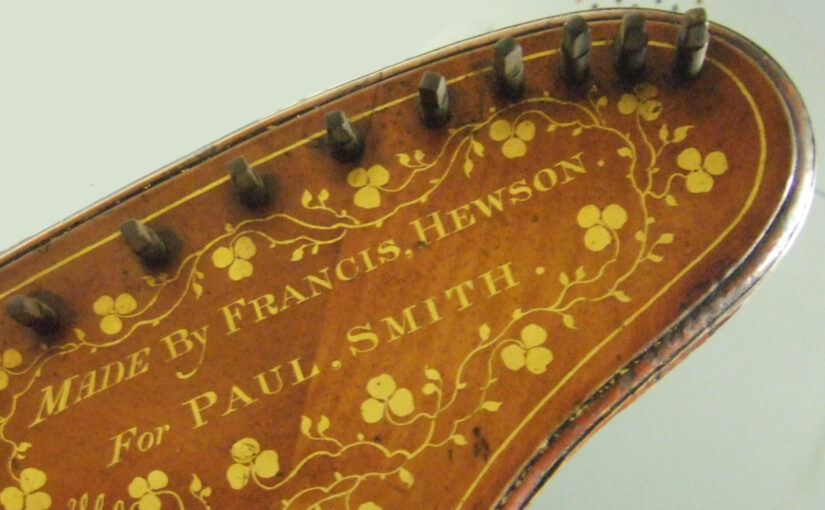
In 1840, Francis Hewson made a traditional wire-strung harp for the traditional harper Paul Smith. My header image (top of page) shows the lettering on the neck of this harp. Francis Hewson’s address is part of the painted inscription.
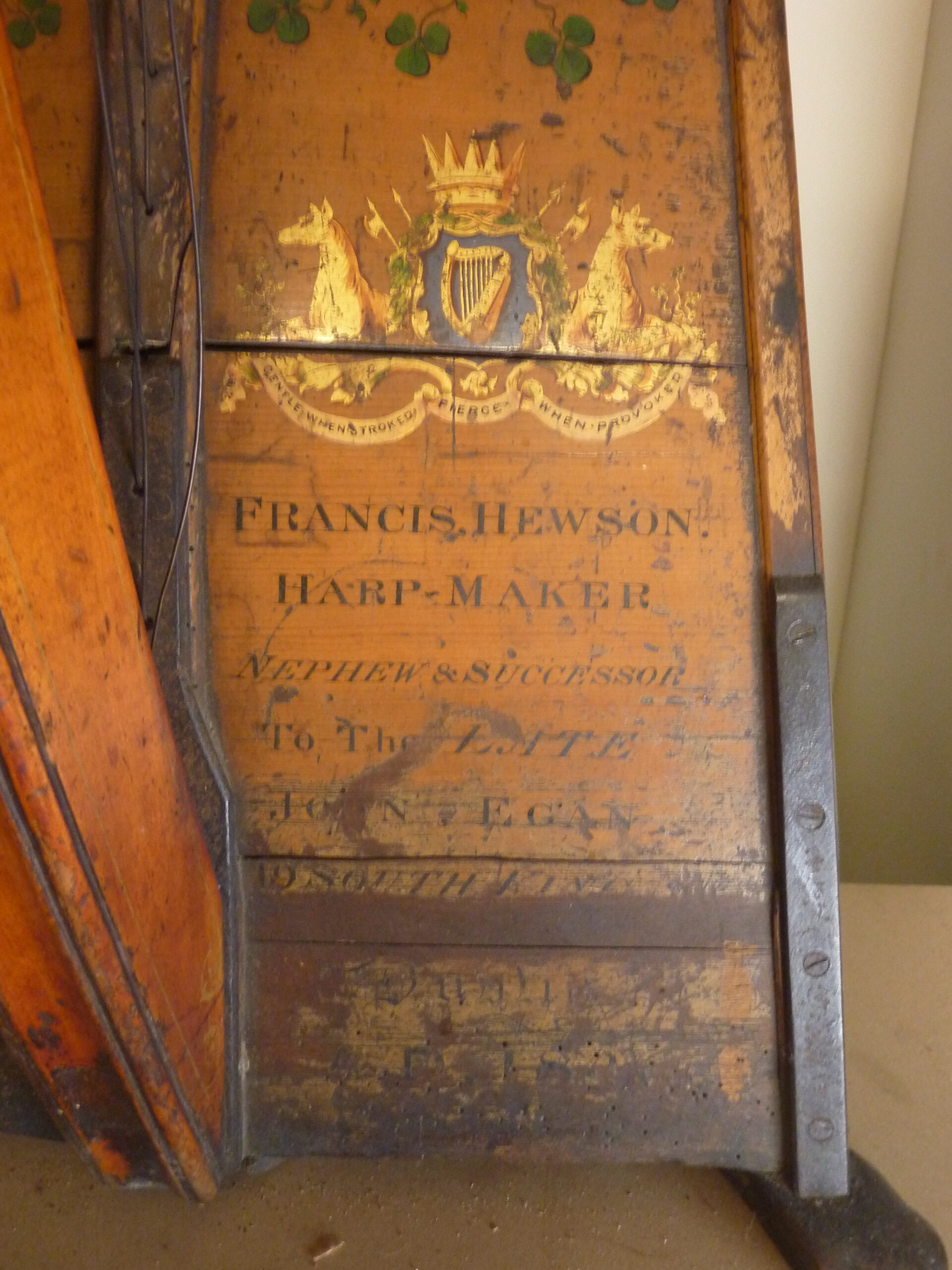
NMI DF:1906.64
The painted date 1840 is very hard to read, since a lot of the paler varnish there has been worn away leaving the darker bare wood, and of course the black painted lettering is on top of the varnish. When the harp was accessioned into the museum in 1906, the date was read as “1840”, and there may have been more of the paint on the harp back then. This close-up shows how on one side only (harp left, right when looking at the front of the harp) still has the remains of the 4 and the 0.

I assume that Hugh O’Hagan’s harp was made around a similar time, though its soundboard lettering is completely covered by over-painting and paper decoration glued on to the soundboard.
Francis Hewson is listed at 19 South King Street in street directories in 1843 (Post Office) and 1846 (Slater’s). But I don’t have any record between 1846 and 1849. At some point the family moved from number 19 across the road to no.37.

In 1849, when he was based at 37 South King Street, Francis Hewson made a traditional wire-strung Irish harp. Unlike the other two he made, he did not put the name of the person who he made it for, and so we don’t really understand at this stage how this harp came to be made. In 1849 there was not a harp school turning out newly-qualified traditional harpers. It is hard to imagine who would be in the market for a traditional wire-strung harp in 1849. I suppose the most likely option is that one of the professional harpers for some reason needed a new harp, and so purchased it from Frances Hewson. It is possible he misread the market and made one anyway, not realising that the schools had stopped. It is possible he heard that Pat Murney in Belfast was starting to teach. In any case, we don’t know who owned or played this harp until the beginning of the 20th century when the classical pedal harpist Owen Lloyd bought it secondhand and used it as a novelty. After his death his son Edwin Lloyd bequeathed it to the National Museum of Ireland where it is object number DF:1951.2.
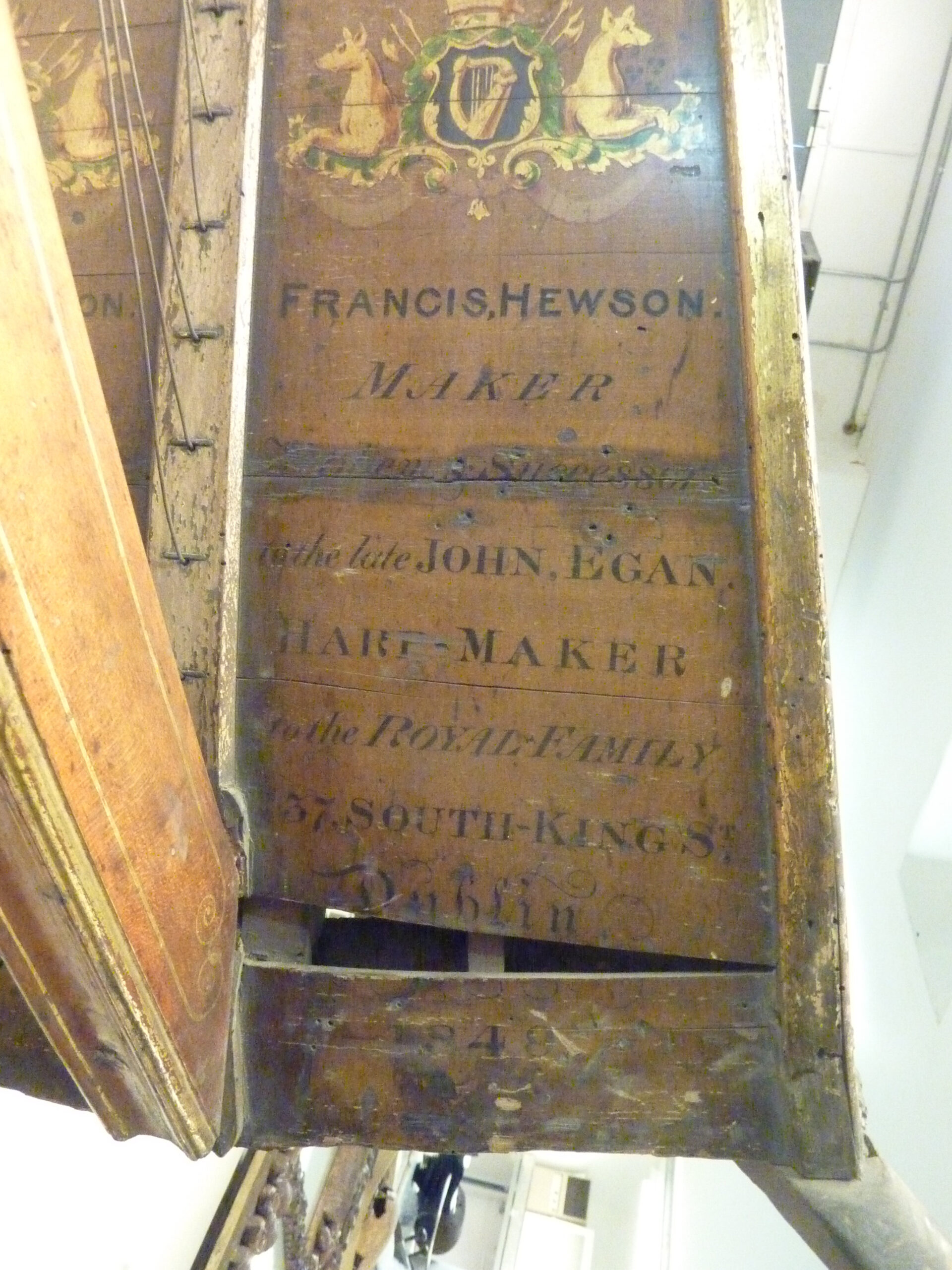
NMI DF:1951.2
Again the date is hard to read, but the other side (harp right) shows the date more clearly:

Francis Hewson is listed at 37 South King Street in street directories in 1850 (Shaw and Thom), and 1851 (Thom). Another business operating from 37 South King Street was a dye works, which had been run by John Walsh in the mid 40s (Saunders’s Newsletter, Thur 5 Nov 1846 p3). John Walsh had died in 1848 (General Advertiser for Dublin, and all Ireland, Sat 22 July 1848 p1), and by 1850 the dye works was operated by John Fulham (e.g. Thom 1850, 1851, 1852).
As I have discussed before, the 19th century census records for Ireland are a disaster zone, with almost nothing surviving. We have very terse abstracts of heads of households in Dublin from the 1851 census, and they show three households at no.37: Fuller, Chandler, and Palmer. Presumably this is John Fuller and his dye works, and two other households renting apartments in the building. This gives us some idea of these big multi-occupancy houses on South King Street at this time. However, Francis Hewson is not listed at no.37 on 30 March 1851.
13 South King Street (King Street South) is where Francis Hewson is listed in the 1851 census. I checked other addresses in South King Street with their occupants in Thom 1851, and we can confirm that the census is using the actual street addresses and not just arbitrary household numbers. No.13 is listed as “tenements” in Thom 1851, and there are nine households listed. Perhaps Francis Hewson had to give up his apartment and workshop at no.37 in the early part of 1851, after submitting his details for the Thom directory (likely at the end of 1850), and before the census night of 30 March 1851.
Another aside: on 18th Jan 1861, Joseph Hewson died, at 19 South King Street, as we discussed above. This is the address where Francis Hewson and his family had been some years previously. Is this a co-incidence, or was there a family connection? I don’t know. I don’t think Francis Hewson had gone back to live at 19 South King Street in 1861.
Anyway, I don’t have any address records for Francis Hewson between 1851 and 1859. He is not listed in Thom 1852. But at some point in the mid to late 1850s the family seems to have moved away from South King Street, to the next street over, to 3 York Street.
Marrying off his daughter
Francis and Mary Hewson’s eldest child was their daughter Maryanne. She was 30 years old by the beginning of 1859, when she married John Murphy. The marriage record from St Andrew’s Catholic Church records their wedding on 27th January 1859. Marianne Hewson is living at 3 York Street, as are her parents Francis and Mary. Maryanne’s husband John Murphy is living at 12 South King Street (next door to where Francis Hewson had been listed in 1851; listed as tenements in the 1858 directory, though there is no Murphy there in the 1851 census). John’s parents James and Jemima Murphy were living on (I think) Francis Street. The witnesses were William Mordaunt of 148 Abbey Street, and Mary Murphy of Booterstown.
Death of his daughter
Maryanne Murphy Née Hewson died exactly one year later, on 27th January 1860, at the age of 31. I am not finding any baptismal record of a child; perhaps she died in childbirth.
Francis Hewson had his daughter buried in Glasnevin cemetery. The cemetery record book lists her burial on 28th Jan 1860. The plot is TG68 in the Garden Section, and there was already a person buried there; John Fane of Crampton Court who had died in March 1848. I don’t know who he was. Anyway, Marianne Murphy’s address is given as 12 South King Street, which is where her husband John lived.
Five years later, Francis and Mary Hewson lost their eldest son. Francis William Hewson died aged 24, on 1st January 1865. I have not seen his death record, but there is a death notice in the newspapers, which says “At his residence, 3 York Street, of bronchitis, Francis W Hewson, in the 24th year of his age. His remains will be removed for interment to Glasnevin Cemetery at ten o’clock on tomorrow (Tuesday) morning. Friends will please accept this intimation. – Requiescat in pace.” (Freeman’s Journal, Mon 2 Jan 1865 p3). The printing is bad and the address “3” looks like “8”, but other reprints clarify that the address really is 3 York Street (Catholic Telegraph, Sat 7 Jan 1865 p7, Weekly Freeman’s Journal, Sat 7 Jan 1865 p8). Francis William Hewson was buried alongside his sister Maryanne in plot TG68.
Perhaps in 1860, or perhaps not until 1865, Francis Hewson erected a large and impressive monument on the grave in Glasnevin Cemetery. The inscription reads:
Gloria in Excelsis Deo
+
Erected By
FRANCIS HEWSON,
of York Street,
in memory of
his beloved Daughter
MARYANNE
who died 27th Jany. 1860.
Aged 30 years.
And also of his beloved Son
FRANCIS
who died 1st January 1865
aged 24 years
Requiescand in pace
F HYNES FECIT
I don’t know what happened to Maryanne’s husband. It is not easy to find a John Murphy in the Irish records, since there are rather a lot of them.
Business at 3 York Street
3 York Street is where Francis Hewson is listed in street directories in 1862 (Thom), 1868 (Thom), and 1870 (Thom). Another businesses operating out of this address at the same time was an agency were you could hire or engage domestic servants (Saunders’s Newsletter, 28 Nov 1867 p4, Dublin Daily Express, Tue 22 June 1869).
In all of his trade directory listings from the 1840s and 1850s, at 19 and at 37 South King Street, Francis Hewson is listed as “harp maker”. But in the directory listings from the 1860s, at 3 York Street, he is listed as “double action harp maker”. We know that Francis Hewson was already making double-action pedal harps back in the 1840s, since he won a “large medal” at the Royal Dublin Society exhibition of Irish manufactures in 1844, for exhibiting a double-action harp (Warder and Dublin Weekly Mail, Sat 15 June 1844 p7). But perhaps it was a change of focus, or perhaps it was just a change of advertising style. Perhaps you had to pay per letter for these directory entries, and perhaps the move to 3 York Street was because he was doing better in business. You can read a bit of context in Clare McCague’s thesis p.32.
I don’t know of any pedal harps made by Francis Hewson. But I have found a couple listed for sale secondhand. “A superior double-action pedal harp, by Hewson” was in the contents of Rev. R. H. Wall’s house, 6 Hume Street, which was to be sold at auction on 23 Dec 1856 (Dublin Daily Express, Mon 15 Dec 1856 p1), and “a double-action harp, by Hewson” is included in an auction listing of the contents of a house in Rathmines (Freemans Journal, 12 May 1877 p8). These are both pedal harps. An “Old Irish Harp; maker, Hewson, Dublin” was advertised for sale in the Dublin Daily Express Tue 9 Jan 1917 p8, and an “Old Irish Harp by Hewson, Dublin, [ca]n be seen at Messrs Hartigan’s Auction [rooms] Davis Street”, listed for sale in a Limerick newspaper of 15 July 1926. These could possibly be pedal harps, though I think by the early 20th century it was less common to refer to pedal harps as “Irish”, so perhaps they are more likely traditional wire-strung harps. By this date the three traditional wire-strung harps we have in the museums were all accounted for so I think these adverts represent one or two extra examples. Hopefully in time an antique pedal harp (or even another traditional wire-strung harp) signed by Francis Hewson will appear.
Second daughter’s marriage
After the death of Francis and Mary Hewson’s other two children, I think that their daughter Theresa may have been the only surviving child, unless there is another son or daughter who I have not found any records for. On 30 July 1866, Theresa was married in St Andrew’s Catholic church. She was 34 years old.
We have both the church marriage record, and we also have the the entry in the civil register, and together they give us good information. Theresa is listed as living at 3 York Street, showing us that she was still living at home with her parents when she married. Her parents are listed as Francis and Mary Hewson, living at 3 York Street. Her new husband was Gregory Murphy, living in Williamstown, who was a widower. Gregory’s parents are Luke and Mary Murphy, deceased. The witnesses are James Jordan, of (I think) 4 Merrion Avenue, and Mary Brady of 13 (I think) Whitefriars Lane. Unfortunately the occupations of both fathers is not given.
Gregory Murphy of Williamstown is a very interesting man for Theresa Hewson to have married. In Thom 1868 (p1748), Gregory Murphy is listed at 1 Seafort Parade, Williamstown, and he is listed as “Builder and County Dublin saw mills”. This is a very handsome house on the corner of Rock Road. Poor Gregory was already a widower when he married Theresa Hewson in 1866; in 1868 he was widowered a second time. Obviously a man who owned a sawmill would be known to Theresa’s father, the harpmaker Francis Hewson.
I think Gregory Murphy may have been related to the John Murphy who Theresa’s late sister Marianne had married seven-and-a-half years previously. One of the witnesses back then to Marianne’s marriage was Mary Murphy of Booterstown; Williamstown is the eastern quarter of Booterstown, which is on the coast just north of Blackrock and just south of Merrion, a mile or two north of Dun Laoghaire.
Death of second daughter
By some tragic co-incidence, Theresa Murphy née Hewson died in August 1868, just over two years after her marriage. She too was buried in the same plot in Glasnevin cemetery, TG68. Her name was not added to the big grand monument, but there is a second much smaller gravestone beside it which I have not yet been able to read. She was buried I think on 30th August 1868. Her burial record gives her address as 1 Seafort Parade, Williamstown.
But poor Francis Hewson; all of his children were dead, and it does not look like he had any grandchildren.
So from 1866 onwards, Francis Hewson and his wife Mary were living at 3 York Street. Francis Hewson was aged around 70 by this point. He is listed in Thom’s street directory, as “double action harp maker”, in 1868 and 1870. But though I checked Thom every year from 1871 through to 1877, I did not find any more listings.
Retirement and death
I don’t know if Francis Hewson retired some time in the 1870s, or if he kept working right through to the end. We simply don’t have any records.
Francis Hewson died on 12 June 1877, aged 80, at the House of Rest, Merrion. His occupation is listed as “Harp Maker”.
It looks like Francis Hewson was buried in Mount Jerome Cemetery, since there is a burial record for Francis Hewson, age 80, buried on 14 June 1877. The plot number is A084-00236. In answer to my query, Mount Jerome told me that this is a “common grave the rights to which are owned by the cemetery”, and so the cemetery would bury unrelated people in this plot, in contrast to plots that were owned by a family (such as the Hewson family plot in Glasnevin). Five people are listed as being buried in this plot at Mount Jerome: Francis Hewson, Charles Ebbs, Margaret Bell, John Cullen and William Boole, with dates of death from 1877 through to 1922. and I have not yet had a chance to go and see the burial plot. I suspect there is nothing there to see.
I don’t understand why Francis Hewson woul dhave been put in an unmarked common grave in Mount Jerome, rather than in his family plot at Glasnevin alongside his children. He died in the care home in Merrion, near to Williamstown where the Murphys lived. Where was his wife Mary at that point?
Meanwhile, his widow Mary lived another 11 years, but we have no record of where or what she was doing. She died on 15th December 1888 in St Patrick’s House, South Circular Road, Kilmainham. She was buried alongside her daughters and son, in plot TG68 in Glasnevin. The burial record gives her age as 86, though her death record gives her age as 88. She is listed in the burial register at Glasnevin: “had been a Harp makers wife”.
My map shows the places mentioned above. Zoom out to see the places further away from where they lived.
Heraldic motifs on Francis Hewson’s harps
Of the three Francis Hewson harps that we know to survive, one ( Hugh O’Hagan’s) has been heavily overpainted so only a bit of the decoration survives. But the other two are in good condition and so the decoration is well preserved.
John Egan’s pedal harps have the usual decorative scheme of English pedal harps, though some have shamrocks instead of Ancient Greek style lining or figures on the flat soundbox surfaces. Egan’s classical miniature harps (the “Royal Portables”) generally also have a similar kind of decorative scheme, though always with shamrocks and not with the ancient Greek motifs often found on the pedal harps. However Egan’s traditional wire-strung harps have a slightly different decorative scheme. They are generally not painted, but have gilt shamrocks on the varnished wood of the neck and pillar, and painted shamrocks on the soundboard. But most distinctively, John Egan also put heraldry and text on the soundboards of his traditional wire-strung Irish harps. The heraldry was the Royal arms, associated with John Egan’s Royal Warrant which he was awarded in August 1821. The lettering on Egan’s traditional wire-strung harps announced his name and address.
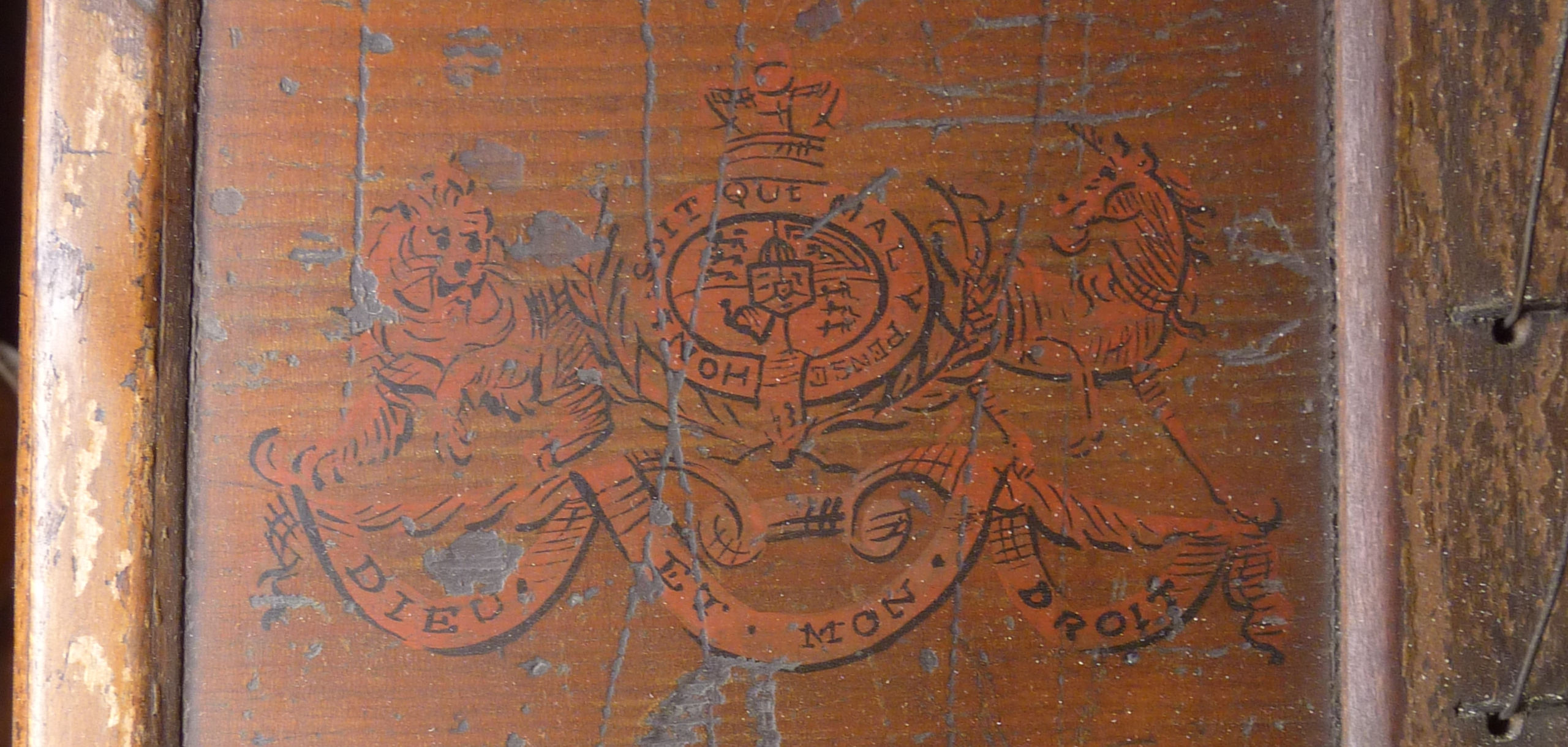
You can see from the image above that John Egan’s hedaldry is applied freehand, and different instruments have more or less neat and elaborate versions of the Royal arms.
Francis Hewson used a very similar overall decorative scheme for his traditional wire-strung Irish harps. His shamrocks are slightly different in style from Egan’s, but the most noticeable difference is that where Egan (after 1821) put the Royal arms, Francis Hewson in the 1840s put an Irish heraldic motif.
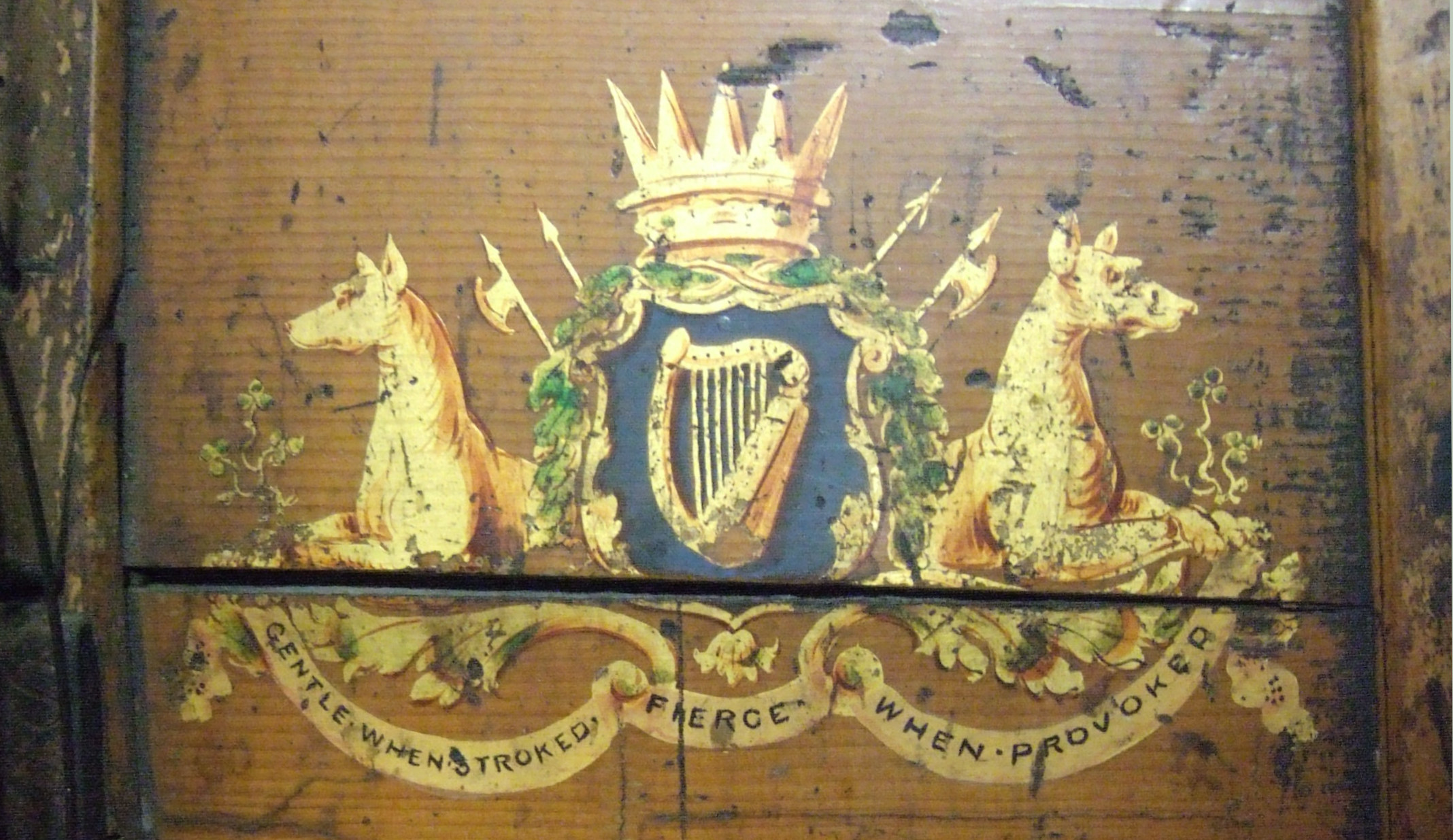
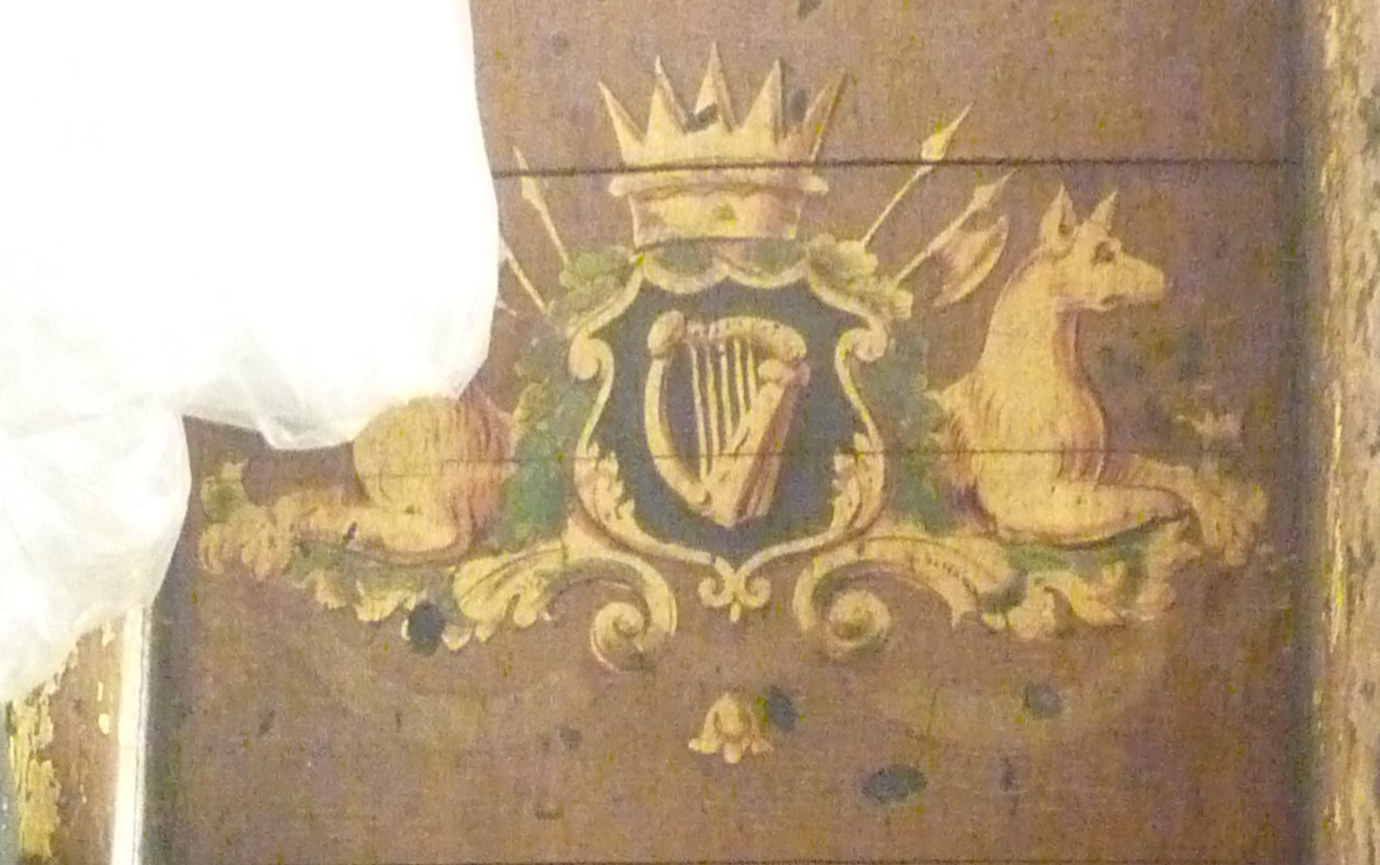
As you can see the heraldic image is much finer than John Egan’s, and is in gold leaf rather than just paint. The blue of the shield is apparently lapis lazuli (it fluoresces very bright pale blue). The two designs nine years apart are not identical, otherwise I would suspect they may be printed transfers rather than hand-painted.
I think this pseudo-heraldic display is actually very interesting from a cultural and political point of view. The idea of an ancient Irish coat of arms seems to have grown in the 1840s, and so Hewson’s 1840 example may be an early example of it. I am not finding any other complete example like this, though the elements of the design were commonly connected with Irish nationalism, and with the Repeal movement in the 1840s. The motto “Gentle when stroked, fierce when provoked” appears not to be a translation of an Irish original, but an English-language Irish nationalistic slogan.
I am suspecting that Francis Hewson may have been politically active to use such a loaded cultural and political design on his harps. Maybe it is connected to him being Catholic and from a Catholic family, working as an artisan and business-owner at the time that Catholic emancipation was beginning to happen.
Has the motto been deliberately erased on the 1849 harp? Or was Francis Hewson or his client in a less Nationalistic and more Royalist mood, since that harp also mentions John Egan’s royal appointment (described above).
It would be a very useful study to try and find more examples of these powerful nationalistic motifs used in this pseudo-heraldic way, to be able to more confidently understand how Hewson’s harp decoration fits into the cultural and political world of early to mid 19th century Ireland and the United Kingdom.
Wider family connections: John Egan
In this post I have tried to concentrate on Francis Hewson himself, and his family. But we should also briefly consider his wider family.
Francis Hewson tells us himself (in the inscriptions on two of his surviving harps) that he was a nephew of the harpmaker John Egan. Nancy Hurrell wrote a book-length study of John Egan (Four Courts Press 2019), but even she could find nothing about John Egan or his wife’s family. Unless Francis Hewson is using the term “nephew” in a rather loose way, we can think that he could be the nephew of John Egan in three different ways. We need more records of the Egan family to be able to pin this all down.
- Francis Hewson’s father Joseph could have been Mrs. Egan’s brother. We don’t have a record of Mrs. Egan’s surname or maiden name. If we found that she was originally Miss Hewson then this could be the most likely possibility.
- Francis Hewson’s mother Margaret could have been John Egan’s sister, but we have no record of this possibility. We don’t have a record of Margaret Hewson’s maiden name. If we found she was originally Margaret Egan then this would be the likely option.
- Francis Hewson’s mother Margaret could have been Mrs. Egan’s sister. We would need to find both their maiden names to match to make this a likely option.
Because John Egan was making traditional wire-strung harps for the Irish Harp Society school in Belfast through the 1820s, I like to imagine Francis Hewson apprenticing with his uncle and specialising in the design of the traditional wire-strung Irish harps, which later fed into the design of his own in the 1840s and his claim to be “nephew and successor” to John Egan. But this is pure fantasy on my part.
Wider family connections: Joseph Hewson
A much less clear potential family connection is to the harpmaker Joseph Hewson. The only family records for Joseph Hewson the harpmaker I can find are his wife and son. I have nothing about his parents or siblings and so we really do not know if he was actually related to Frances Hewson. But the sharing of given names and being in the same places makes us suspect that they are relatives.
Joseph Hewson married Elizabeth Major, and apparently they had two sons. Joseph Francis Hewson was baptised in 1846 but I have no further records of him. He may have died young, since his first name Joseph was also given to a subsequent son.
Joseph Thomas Hewson was baptised on 3 Jan 1850, at St Andrew’s Catholic church in Dublin. He worked as a shop assistant, and on 28 Nov 1874 he married Penelope Mary Osborne née Kelly, a widow. They lived at 18 Charleville Avenue, where both died, Penelope on 12 Apr 1892, and Joseph Thomas on 31 Oct 1893.
I have not found any records of Joseph’s parents or other family. But I do wonder if he may have been related to Francis Hewson. They could have been brothers, or cousins, or Joseph may have been a generation younger, perhaps a nephew of Francis Hewson or even a son. We see that Francis Hewson’s first child was baptised 18 years before Joseph’s, so Joseph seems like he may be almost a generation younger than Francis was. When Francis Hewson baptised his daughter Maryanne in December 1828, one of the godparents was called Joseph Hewson. Is this Joseph Hewson the harpmaker, or would he have been too young at this point?
Joseph Hewson the harpmaker does not seem to have had his own harpmaking business, but worked making harps for other brands. From around the mid 1840s he was apparently in charge of harp making at John Bray’s musical instrument shop, 26 Westmoreland Street. Presumably he made things like the “patent double-action harp in birds-eye maple and gold” exhibited by John Bray at the New York Exhibition in 1853-4.
I think it is at least a possibility that Joseph Hewson may also have originally apprenticed at John Egan’s workshop in the eighteen twenties or thirties. He had to have learned harp making somewhere.
Joseph Hewson died on 18 Jan 1861. His death notices in the newspapers say he died at 19 South King Street (The Nation, Sat 26 Jan 1861 p352; Dublin Weekly News, Sat 26 Jan 1861 p8; Weekly Freeman’s Journal, Sat 26 Jan 1861 p8), and they are the source of the information that he had been 15 or more years working for Bray.
When we looked at the mentions of pedal harps above, It is curious that they are all described as made by “Hewson”, not made by Francis Hewson. Is it possible that Joseph Hewson made some of them and signed them with his own name? Unless we find one it is impossible to know.