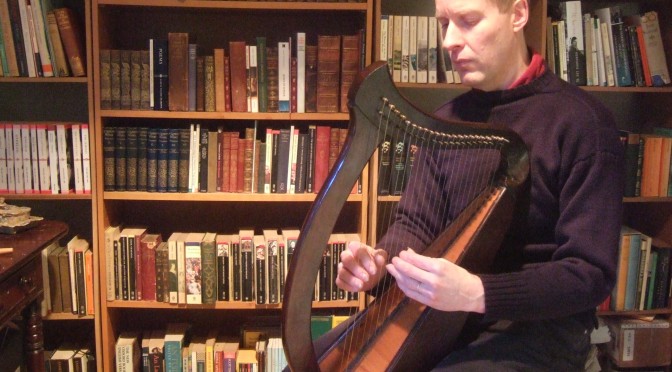
Earlier this year the Historical Harp Society of Ireland acquired an interesting harp, made by James McFall in Belfast.
I don’t know the exact date of manufacture, but it must be between about 1900 and 1950. We know that McFall adverised the availability of harps withe wire strings as well as the more usual gut-strung revival instruments.
The harp has 22 strings, and as found it retained many old strings, showing a scheme with four wound basses and the rest of plain iron wire.
The shape of the harp is similar to other smaller McFall harps I have seen, except that unlike all his others, this one has a square back instead of his usual rounded back. It seems likely to me that the square back combined with the extant iron strings are fair hints that this was designed as a wire-strung harp.
I measured all of the remaining strings carefully before removing them, and individually bagging and labelling them to be kept with the harp as its ‘archive’, before fitting new strings. I tried to match the old strings, using Malcolm Rose’s soft iron of similar gauges.
Because the harp has a very thin, braced, crossgrain soundboard, it has a very boxy, tinny, twangy sound, very different from a good replica early Irish harp as we aee used to today. But I think it is very interesting to think about how an instrument like this might have been used as part of the early 20th century revival of the early Irish harp.
I have chosen a traditional Irish midwinter song air, from Bunting’s 1809 volume, for this video.
James mcfall was my great grandfather and his grandson malachy mcfall who worked on the harps with his grandfather
Malachy is still alive at tge ripe age of 91and lives in canada.
My dad sold the last harp they made together to come to canada
I just thiught you be interested in hearing abit of mcfall history
I have a small McFall harp here in Lincolnshire UK which I am selling on ebay some time soon. Robert.
I too have a James McFall harp with lovely Celtic knot gilded decoration and cross-grain sideboard. When I got it about 35 years ago, it was strung with gut strings, though quite a few were broken. I got a set of synthetic replacement strings, but left the original gut strings which were still intact. It has insteresting sharping mechanism — just an eyelet screw that you turn to sharpen the note. I can send pics if you like.
John
Thanks John, always happy to see photos, if you email them I can add them here to your comment.
Dear All, I’ve got a beautiful harp from an elderly lady originally from Belfast. She past away long time ago . Unfortunately I dont know the history of this beautiful instrument, but by the look of it and the origin it may be long time forgotten one of famous James McFall creation. Im.hqppy to share the pictures with you.
Regards, Arthur
Here are Arthur’s images:
I too have a McFall harp. Had it almost 4 decades, and it was pretty ancient when I got it. Like with another post to this site, I replaced broken gut strings with synthetic and a couple string pins. The soundboard appears to be thin spruce with grain running transverse to the principle axis of the instrument, such that I felt uncomfortable tuning beyond a step below concert pitch because of the amount of soundboard deflection. Has handsome gilded celtic knot artwork on the soundboard
Happy to provide pics.
John LeCroy’s photos