
Hugh Fraser (or Frazer) is an Irish harper whose name appears quite often, because he taught the harp in Drogheda in the 1840s. This post is to draw together other references to him, to try and build more of a picture of him and his life.
Continue reading Hugh Frazernews

Bridget O’Reilly
I don’t know very much about Bridget O’Reilly, but I thought it might be useful to start gathering references to her. There are also a few references to un-named female harpers which might possibly be her. Hopefully in time we will find more detailed references which will allow us to tell more of her story.
Continue reading Bridget O’Reilly
Hugh O’Hagan
Hugh O’Hagan has been known as a harper from the Oriel region for a long time, but there has been very little information about him. I have done some digging over the past few months and this post draws together what I know now.
Continue reading Hugh O’Hagan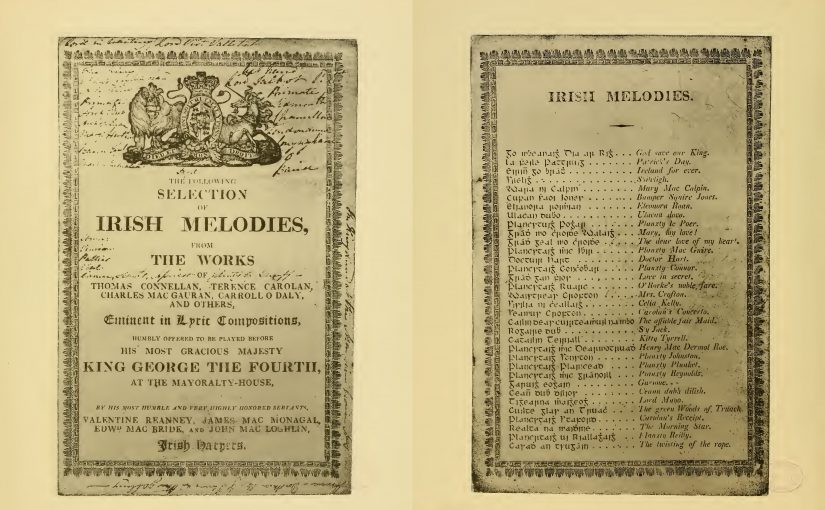
19th century Irish harp tune lists
When I was doing my newspaper research a month or two back, I found quite a lot of mentions of tunes played by individual named harpers. I realised that I could usefully try to collate all these different references, to get some kind of overview of what were the most commonly mentioned tunes in the inherited Irish harp tradition through the 19th century.
Continue reading 19th century Irish harp tune lists
Féachain Gléis
When I started my Old Irish Harp Transcription project, one of my aims was to move away from what had been happening before, where people focussed in on particularly interesting, curious or unusual tunes, and studied them intensively while kind of ignoring the broad context of other tunes in the manuscripts.
However, now that I have pretty much gone through all of the “ordinary” harp tune transcriptions I am just left with those unusual ones. I did consider ignoring them but I think there is value in dealing with them. But I think I have to do them a bit differently.
So, for this tune we will discuss four aspects of it. First, we will look at its position in the manuscript, which raises some important questions about Bunting’s collecting process. Then, because it is one of the most studied old Irish harp tunes, we will briefly consider what other people have written about it. Thirdly, we will talk a little about parallels in other traditions. And finally we will think about it in the context of a pentatonic modes analysis.
Continue reading Féachain Gléis
Coolin, or Lady of the Desert
The Coolin, or the Lady of the Desert, has been discussed a lot by Irish harp scholars over the years, most recently by Siobhán Armstrong in her PhD thesis (Middlesex 2020). However it is an incredibly muddled subject. I am not sure if we have one tune or two; I am not sure if the titles are connected or garbled; the live transcription notation from a harper looks like it has been heavily over-written and edited, so that we cannot see the initial live transcription dots; and in general this is the kind of problem notation that I have been silently skipping over in my Old Irish Harp Transcriptions Project.
However we should try to begin untangling some of these threads, and try to say something useful about all this.
Continue reading Coolin, or Lady of the Desert
Two letters to Edward Bunting
In 1839, the elderly Edward Bunting was living in Dublin and was preparing the piano arrangements and text for his final publication.
Two Belfast gentlemen wrote two different letters to him, about the then-still-living Irish harp tradition.
Continue reading Two letters to Edward Bunting
Mystery Dots
In Edward Bunting’s transcription pamphlets from the 1790s, there is a page which has a whole load of dots and titles that I don’t understand. On this post we will look at this page and see if we can make any sense out of any of it.
Continue reading Mystery Dots
Dawn of Day
In the 1790s, Edward Bunting made a notation of a tune titled “Dawn of Day”, apparently as a live transcription from the playing of the old Irish harp tradition-bearer Denis O’Hampsey.
In this post we will have a look at the live transcription notation and try to say something useful about it.
Continue reading Dawn of Day
John Jones
In one of Edward Bunting’s little collecting pamphlets from the 1790s, there is a two-page opening containing a live transcription notation and expanded neater version, or the tune of John Jones. You can see the two pages online. They are Queen’s University Belfast, Special Collections, MS4.29 page 164/162/171/f80v and page 165/163/172/f81r
Continue reading John Jones