We can just continue with Patrick Byrne. This post follows his trip to Scotland in the first half of 1847, and his return to Ireland for the second part of 1847; and then his work in the English midlands in the first part of 1848, and back in Ireland especially around County Cavan in the summer and early autumn of 1848.
Continue reading Patrick Byrne part 7: 1847-8news

Patrick Byrne part 6: 1845-6
We have so much information about Patrick Byrne that I am concerned whether this series of blog posts is going to get too much for me. John Scully made an entire book of “not the complete story” of Patrick Byrne’s life (Ah how d’you do sir, Carrickmacross 2024). But I think there is still value in me continuing to try and work through every single reference I can find about Patrick Byrne, in an attempt to trace his life story. So we will carry on here for now.
This post will cover Patrick Byrne’s activities from when he travelled back to Ireland at the end of June 1845. We will try to follow Byrne for about six months in Ireland to the end of 1845, and then for the first half of 1846 in England, and finally for the second half of 1846 touring the north of Ireland, including a very interesting paper trail of letters of introduction from aristocratic patrons.
Continue reading Patrick Byrne part 6: 1845-6
Hugh Higgins
Hugh Higgins was a traditional Irish harper in the 18th century. He is said to have died in 1796 so he only just gets a place in my Long 19th Century project, looking at harpers who were active from 1792 through to 1909.
Continue reading Hugh Higgins
a blind girl in the South of Ireland
“There is a blind girl in the South of Ireland who plays on the old wire-stringed Irish harp” says a newspaper from one hundred and twenty-six years ago, without giving us any more information at all. This post is for her, so that we can try to work out who she might have been, or to try and sketch the wider context that might give us a clue as to where she might have come from and what she might have been doing.
Continue reading a blind girl in the South of Ireland
Daniel Black
Daniel (or Donald) Black was a traditional Irish harper in the 18th century. He was alive in 1792 and so we have to say something about him as part of my Long 19th Century project, to investigate the traditional Irish harpers who were active from 1792 onwards.
Continue reading Daniel Black
Another traditional Irish harper in the 20th century
In my timeline of traditional Irish harpers through the Long 19th Century, I have listed three people who were still alive after 1900. Peter Dowdall in Drogheda died in 1902; Paul Smith in Dublin died in 1904, and George Jackson in Belfast died in 1909. All three of these had learned to play the traditional wire-strung Irish harp from teachers who themselves had learned in the inherited tradition with lineages going back to the 18th century and beyond.
This post is to discuss a very brief mention of an un-named harper in 1906.
Continue reading Another traditional Irish harper in the 20th century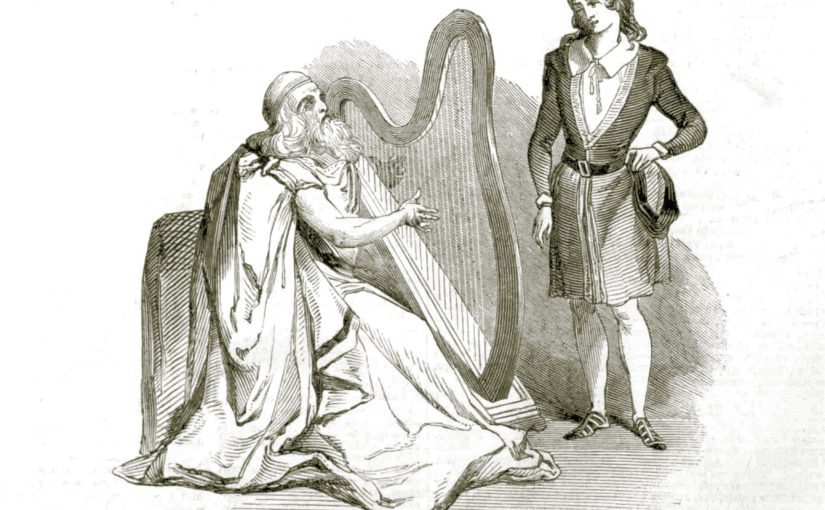
Patrick Byrne part 5: Scotland, 1845
In Part 1, I wrote about Patrick Byrne’s early years and education, down to his discharge from harp school in 1822. Then in Part 2, we looked at his early career, working for patrons in Ireland and England from 1822 to 1837. Part 3 covered his first visit to Scotland over the winter of 1837-8, and his tour of Ireland in 1839-40. Then in Part 4 we looked at him playing for Queen Victoria at Windsor Castle, and then touring mostly in Ireland and a bit in England in 1841-4.
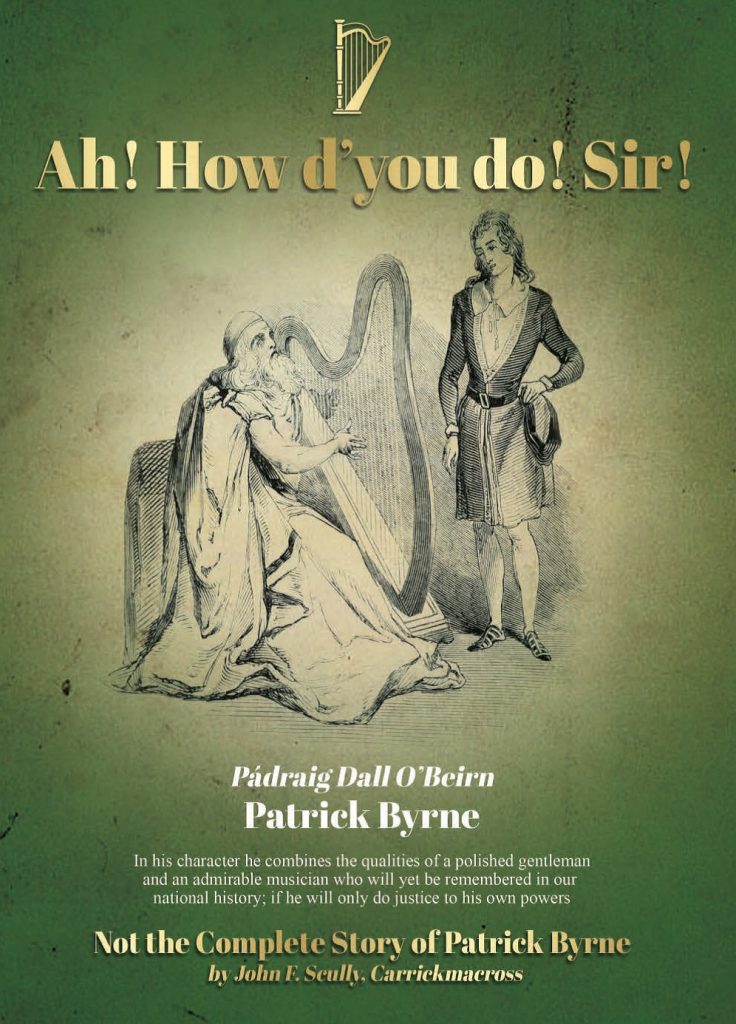
Since I posted part 4, John Scully has published his book Ah how d’you do sir (Carrickmacross, 2024) which gathers records of Byrne’s life, including many that I have included in my posts but also some that I had not found. I will refer to his book when he has found things that I didn’t know about. I have a few copies of John’s book in my shop.
By 1845, Patrick Byrne must have been around 50 years old. He was working hard, buoyed by his Royal patronage and his extensive networks of aristocratic patrons. At the beginning of 1845, he set off for his second trip to Scotland. It was a busy trip, and so this post will follow him for about six months, from when he went over at the beginning of 1845, until he headed back to Belfast on 25th June.
Continue reading Patrick Byrne part 5: Scotland, 1845
Michael Deigan
Michael Deigan was a harp maker, player and teacher in the south-west of Ireland in the 1840s. We have a huge problem because at the moment we don’t know if he was a classical harpist, or if he had learned to play the traditional wire-strung Irish harp in the inherited tradition. This post is to try and say something useful about him.
Continue reading Michael Deigan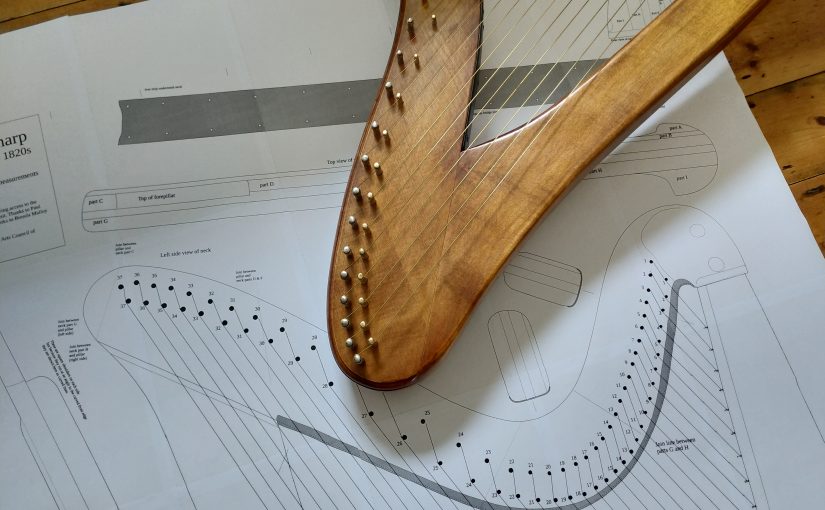
Egan harp scan and drawings
One of my recent projects has been to create a set of harpmakers’ plans and templates for making a 19th century style traditional wire-strung Irish harp.
Continue reading Egan harp scan and drawings
Charles Fanning
Charles Fanning was a traditional Irish harper in the second half of the 18th century. Because he was still active in 1792, I ought to try and say something about what he was doing during my “Long 19th Century” study period (1792 – 1909).
Continue reading Charles Fanning