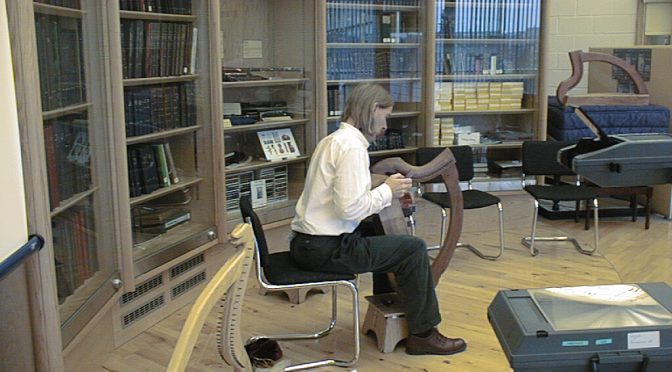
Today I presented my concert in St Andrews, “the Memoirs of Arthur Ó Neill”.
I read excerpts from his autobiography, and played the tunes referred to in the anecdotes.
Here is my video of the complete, half-hour performance:
Today I presented my concert in St Andrews, “the Memoirs of Arthur Ó Neill”.
I read excerpts from his autobiography, and played the tunes referred to in the anecdotes.
Here is my video of the complete, half-hour performance:
Edward Bunting‘s first field notebook, which he used to take down live transcriptions from the old harpers in 1792 and later, is kept at Queens University Belfast, Special Collections, MS4/29.
Usually known as ms29, it is a small oblong notebook stuffed full of sketchy drafts and scribbled transcriptions from the playing of the last tradition bearers.
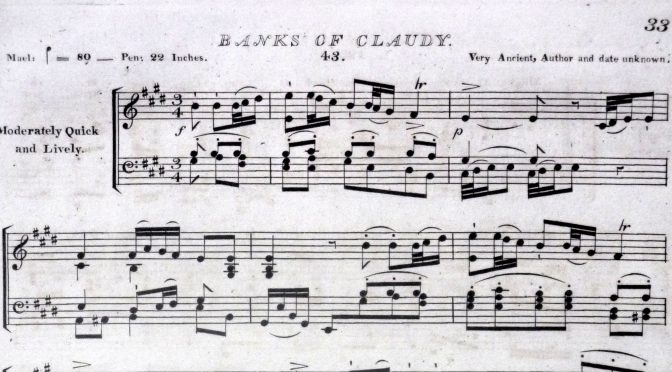
On page 1 of the book is a two-staff arrangement of “The Banks of Claudy”.
Speaking on 10th July, 1849, the Irish harper Patrick Byrne explained to the antiquarian John Bell, the system for tuning the early Irish harp. After starting at na comhluighe, and using a cycle of 5ths to set the middle octave of the harp, he says
Then you sound the G on the violin & B & D, and the octave above which is G which makes a common chord
I’ve been playing almost every day now for a week and a half, using the tips of my fingers, with my nails trimmed short. Here are a few preliminary observations.
Continue reading Some observations on playing with finger-tips
Today I was working on tunes collected by Edward Bunting from the 18th century Irish harper, Arthur Ó Néill, for my concert in St Andrews on 3rd August.
As I played through some of his settings of Carolan and other baroque Irish harp music, using a copy of an 18th century Irish harp, I started thinking about the whole issue of playing the harp with long fingernails.
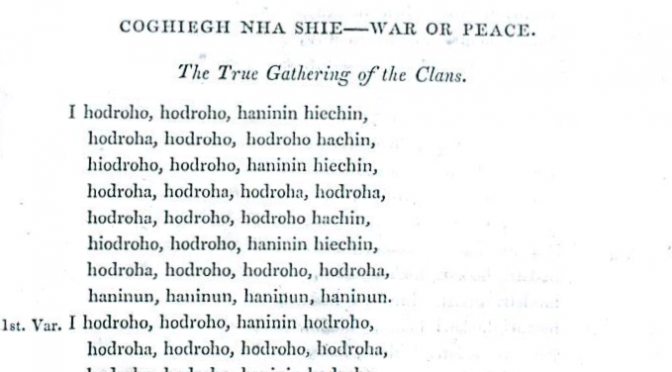
Today in St Andrews I played the second in this summer’s season of medieval harp concerts. I chose to play the traditional piobaireachd, Cogadh no sith (war or peace), re-imagined as a medieval ceremonial march for the Lords of the Isles.
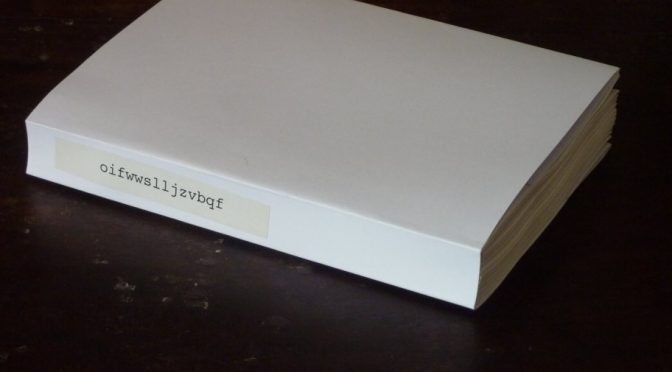
I came across Jonathan Basile’s Library of Babel a while back. This online project has created (in virtual form) the “universal library” imagined by Borges, containing in this case, every possible page of 26 letters. Of course, that means that it does indeed contain this blog post – at least the beginning of it.
I am working on the pìobaireachd or ceòl mór, Cogadh no Sith, for this coming Wednesday’s lunchtime concert in St Andrews.
My idea is that this grand geometrical composition can stand as a kind of proxy for the lost medieval Gaelic harp repertory, which would have been played on the Queen Mary harp in the great hall at Finlaggan in the 15th Century for the Lords of the Isles.
I have been reading The other classical musics edited by Michael Church (Boydell 2015). When I first saw this book, in Blackwell’s bookshop in Oxford, I thought I wouldn’t like it; I thought the idea of “classical music” as a general concept was too problematical. I kept thinking about the issues though, and later I had another look in Topping’s bookshop here. So I realised I had to get it and read it.
I think I first played a public concert on the harp almost 10 years ago, on 4th October 2006, for the first ever Friends of Wighton lunchtime concert in the Wighton Centre in Dundee.
But yesterday’s in St Andrews was the first I have ever tried filming.