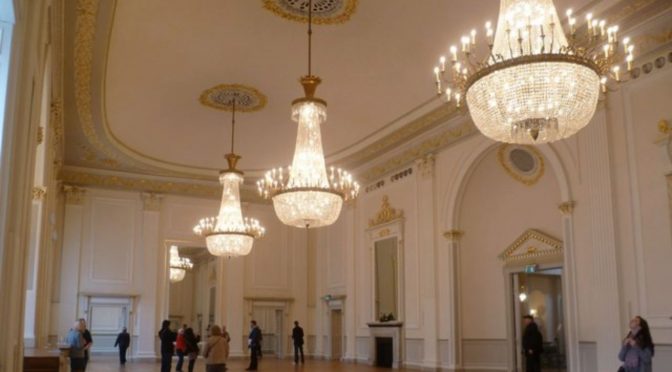
On Friday 20th January, I will be in the Assembly Rooms in Edinburgh, playing as part of a bicentenary concert. Nathaniel Gow introduced Quadrille dances to Edinburgh in 1817, at his annual ball at the Assembly Rooms, and this year Talitha MacKenzie has organised a series of events commemorating this. The main event will be a Regency ball on Saturday 11th March, but there will also be dance workshops and the concert on 20th Jan.
news
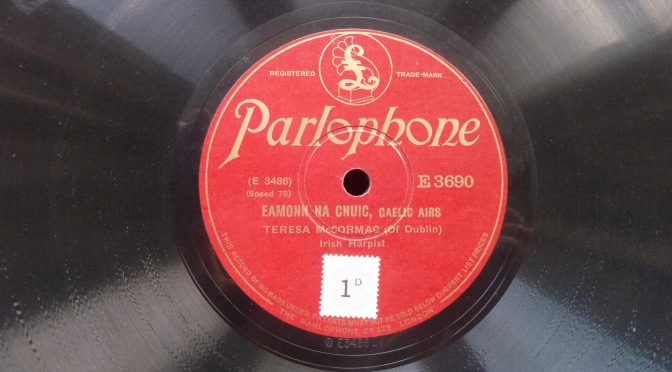
Teresa McCormac of Dublin
I found a shellac 78 disc of Irish harp played by Treasa Ní Chormaic. I don’t know the date of this disc.
Update Jan 2018: Bill Dean-Myatt says it was recorded circa September 1930
I have transferred both sides onto mp3 for you, using a modern turntable.

Scotland’s Treasures
For the next month, you can view the BBC TV documentary Scotland’s Treasures on iPlayer.

Scots Trad Music Awards
I have been nominated as “music tutor of the year” in the annual Scottish Traditional Music Awards.

Performance
A few different things I have been reading recently have come together in some vague and half-baked ideas on performance issues.

Colonial views of Gaelic harp traditions
Yesterday I gave my lecture on the clàrsach or Gaelic harp, to the undergraduate students on the Scottish Music degree course at the University of St Andrews.
As is my wont nowadays, I filmed the lecture for you, but there was a mix up with my battery charging, and the camera died 40 minutes in, so you are missing the last 11 or 12 minutes.

Vermilion
Karen Loomis discovered the presence of mercury in the red pigment on the Queen Mary harp, when she did X-ray fluorescence analysis in 2010. This pretty much confirms that the pigment is vermilion, a mercury sulphide compound.
Karen reported that only the pigment on the curved body of the fish on the forepillar indicated mercury; the pigment on the flat panels of the forepillar contained no mercury. A rendering of the CT-scan data printed in her Galpin Society Journal article (vol LXV, 2012, p.166) shows high-density spots in the crevaces between the interlace of the fish shoulders, and also around the fish eye.
As soon as Karen told me about this I thought of re-painting my replica. Continue reading Vermilion

Medieval Gaelic harp setup and repertory
At Scoil na gCláirseach last month I presented a lecture and a workshop on the medieval Gaelic harp traditions. The lecture outlined my recent work on the setup and tuning of the medieval Gaelic harps, while the workshop later in the week explored the different strands of evidence for medieval Gaelic music.

Reflections on Scoil na gCláirseach
I was in Kilkenny the other week, for the fourteenth annual Scoil na gCláirseach – summer school of early Irish harp. During the week, I explored some of the issues I have been working on so far this year, namely the new setup for the medieval Gaelic harps, and the issues of using fingertips instead of long nails for playing the 18th century Irish harp repertory.

ruder performers only
Reviewing my version of Carolan’s Concerto which I played at Wednesday’s concert, it struck me that this old setting of mine (which I learned many years ago) was pretty clunky and crude. I was reminded of John Lynch’s 1662 assessment of fingernail playing: