news

Irish libraries

I’ve been working in a lot of libraries recently. I love seeing inside different library buildings – the ambience and atmosphere and architecture sometimes seem as important as the collections.

Armagh Public Library was set up by an act of parliament which stated that it would always be called the Public Library, but they changed its name recently and it is now called the Robinson library after its founder, Archbishop Robinson. It is a handsome 18th century classical building stuffed full of handsome 18th century leather-bound volumes. This is the most elegant and beautiful library but is the hardest to make practical use of because its collections are so old-fashioned! I did check out their copy of the Memoirs of the Marquis of Clanricarde, to understand more the preface which famously mentions the performance of bardic poetry with harp accompaniment.

I had previously seen a copy of this book at Luggala. I remember somewhere reading an opinion that Garech Browne’s was the finest private library in Ireland, but I never managed to get to see inside – there was always some excuse, or distraction.

In contrast, the Irish and Local Studies library in Armagh is hidden round the back of a council building, entered through a basement door at the back of a car park. It has excellent collections of journals and newspapers – I never even got to go into the rooms with books! I found some very interesting references in very obscure 19th century periodicals here.

The other interesting library in Armagh is the Cardinal Tomás Ó Fiaich Memorial Library and Archive. I have not done proper research here, only browsed, but it has interesting local studies collections.

In Dublin I have been working at the National Library of Ireland, and also at the Royal Irish Academy. Both have beautiful buildings, and excellent collections; I have mostly been looking at specific unique items there. I have especially been reading the RIA minute books from the 19th century – I have not found what I am looking for in them, but that in itself is kind of interesting. They are really fascinating objects, full of the signatures of the Great Men like Petrie and Wilde. I have more references to follow up especially at the NLI, but it is harder to do because they are not so easy to get to.

In Belfast I have been using the Linen Hall Library and the McClay Library at Queens University Belfast. The Linen Hall library is a lovely old building full of lovely old collections, while the McClay is a really impressive new building with a tower that reminds me a little of Cambridge University library. The McClay holds the Queen’s Special Collections, including the Bunting manuscripts, and so has been extremely useful for me.

A library I have been involved with creating for over a decade now is that of the Historical Harp Society of Ireland; this library unfortunately remains merely a collection of books, since it has no librarian and no building. Maybe in time that will change.

There are other libraries which I would like to get access to. Another private library I have been in, but not used, is that at Clonalis House. There is Marsh’s Library in Dublin. And there is the curious local studies library at Benburb – it was closed when I visited, but I should try again.

I am sure there are others that I have missed…

Triple harp tuning key

I was thinking for a while about the three-armed tuning key which is illustrated in Mersenne’s 1635 book, Harmonie Universelle. Joan Rimmer says in her article ‘The morphology of the triple harp’ (Galpin Society Journal XVIII, March 1965) “the three-armed tuning key still used in Wales is identical with that shown in Mersenne’s diagram”. I remember Tim Hampson showing me one, which fitted the three different sizes of tuning pin drives on a reproduction 18th century Welsh triple harp he had made.

I made my triple tuning key from brass, but instead of three close sizes to fit three types of pin on one harp, I used three very different sizes to fit all different kinds of harps. The huge socket will fit the Carolan harp replica; the middle sized socket will fit Student harps with standard American pedal-harp pins; and the tiny socket will fit modern minis such as the Dolmetsch harp or Ardival Kilcoys.

Now I have made it I am thinking it is a bit too small to be totally comfortable to use; the arms should be 1 or 2cm longer. But it makes a great keyring tuning key.

I’ve listed it on my tuning pins for sale page – if you want one you know where to come!

The year with three Easters

We are used to years with two Easters, and two chances to guzzle chocolate eggs, but this year there are three!

In 2019, the vernal equinox is at 21:58 UCT on Wednesday, 20th March. The full moon is 01:42 UTC on Thursday 21st March. So Easter, the first Sunday after the first full moon after the equinox, is on 24th March 2019.

Catholic and Protestant Christian churches use a theoretical equinox and a theoretical moon, which don’t accurately keep track of the real world, and so their Easter is 21st April. Orthodox Christian churches use a different theoretical equinox and moon, which is even worse at tracking the real world, and so their Easter is 28th April.

Bede, in The Reckoning of Time, describes Ēostre, supposely a pagan English deity, who gave her name to the month Ēosturmōnaþ. The idea of the first Sunday after the full moon after the vernal equinox seems to me to be connected to spring, and to light. The equinox has equal light and dark, the full moon lights the night all night; and Sunday is named for the sun so I suppose is the “brightest” day of the week. Lining them all up in this way, and delaying each after the next, gives a kind of ultimate bright day and night. I wonder if we are meant to stay up all night, and then look in the morning to see both the just-past-full moon and the sun above the horizon opposite one another.

My header image shows a screenshot from https://stellarium-web.org/

Laying out the pins on the neck of the harp

In 2011, Michael Billinge wrote an interesting observation on the layout of the tuning pins on the neck of the Downhill harp. Talking about the way the tuning pins become more spread along the cheek band, as the angle of the neck becomes higher in the bass, he writes: “instead of an even change across the range, as might normally be expected, he seems to have done this in a series of blocks or groupings”

In his footnote, Billinge gives a list of the gaps between adjacent pins, and the way that they increase in steps. My chart below gives a visual representation of his data:

Pins spacing on the neck of the Downhill harp (mm) (data from Michael Billinge)

What made me think of this was that I was doing the same work this week on the Carolan harp. I tagged points on the laser-scan corresponding to the cheek-band holes in the left side (string side) cheek band, and then calculated the distance between each one. Plotting a graph of these distances showed clear groups of similarly-sized spaces.

Tuning pin spacing on the neck of the Carolan harp (mm)

Billinge does not say what the error margin on his measurements are, and so it is difficult to analyse them further. On the Carolan harp, the error on the picked points is less than 0.1mm, but the selection of what points to pick is much less accurate than that, since the scan is quite messy around the tuning pin, with lots of scanning artefacts. I would estimate the accuracy of my measurements as perhaps ±1mm

You can see on my graph that there is a certain amount of zig-zagging, alternating around an average value. I saw this also on the spacing of the string shoes on the belly, but I explained that as an artefact of the alternating shoe design. I’m less sure how to understand this alternating spacing on the neck.I have not done such a detailed measurement of any of the other harps, but the point positions of the tuning pins as used to generate the string charts for the Kildare and the Mullaghmast harps can be used to analyse the pin spacing. The accuracy here is perhaps more like ±3mm. The Kildare seems to show some evidence of grouping, but the Mullaghmast pins are clearly spaced incrementally, with each pin a little further from its neighbour than the previous one.

Pin spacing on the neck of the Kildare harp (mm)


Pin spacing on the neck of the Mullaghmast harp (mm) (cropped, the largest spacing is 116mm)

We could follow Billinge by averaging each group on the Carolan harp, and calculating a standard deviation from the average:

Pins 1-3: 17±1.5mm
Pins 3-6: 14.5±6mm (too erratically placed to say much)
Pins 6-12: 13±1.5mm
Pins 12-19: 14.5±1.5mm
Pins 19-26: 18.5±1.5mm
Pins 26-30: 22±1mm
Pins 30-32: 26±1mm
Pin 32-33 crosses the opened neck-pillar joint.
Pins 33-36: 28.5±1mm

I think this kind of analysis can give us ideas about the working methods of the old harp makers. We can imagine the makers of the Downhill and the Carolan harp, working with dividers to lay out groups of pinholes on the metal cheek-band, as well as using dividers to lay out the string-shoes equally spaced on the soundboard.

What then of the Mullaghmast harp, with its progressive spacing? A different school of harpmaking?

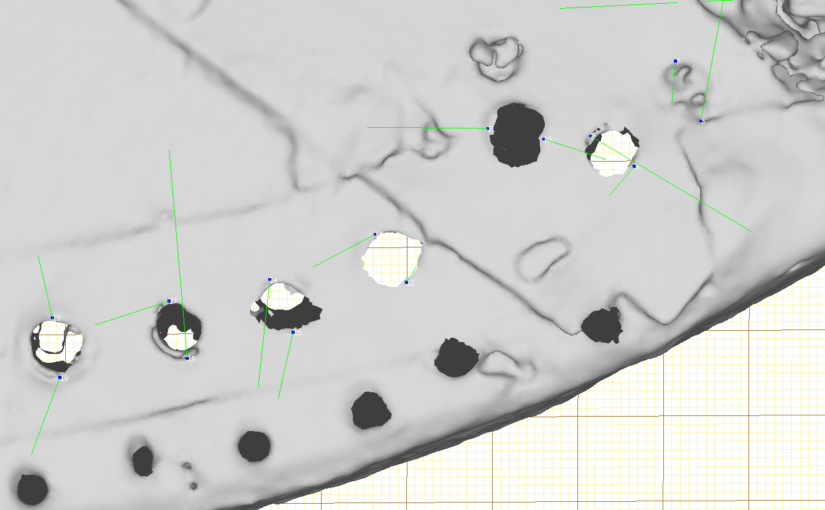
My header photo shows a rendering from the laser-scan, showing two points picked for holes 9, 8, 7, 6, 5, and 4. The position of each hole was calculated as an average of the positions of the two points. The background grid is 1mm x 10mm. The messy damage around hole 3 and the break in the neck is visible in the top-right corner.

Denis O’Hampsey as a progressive

Edward Bunting was fascinated by the aged harper Denis O’Hampsey. Bunting visited him in Magilligan in the 1790s, making live transcriptions of O’Hampsey’s playing into his pocket notebook, and much later eulogising him in 1840 as some kind of living fossil, preserving a much more ancient strand of the Irish harp tradition than any of the younger harpers.

Continue reading Denis O’Hampsey as a progressive

3d photography as a measurement tool

The bass end of the Carolan harp (which was sometimes called the Rose Mooney harp) is very damaged, and there has been a lot of movement inside the bass joint. However it’s not possible to measure this movement from the outside, because of the later repairs with iron straps and canvas bandages completely covering this part of the harp.

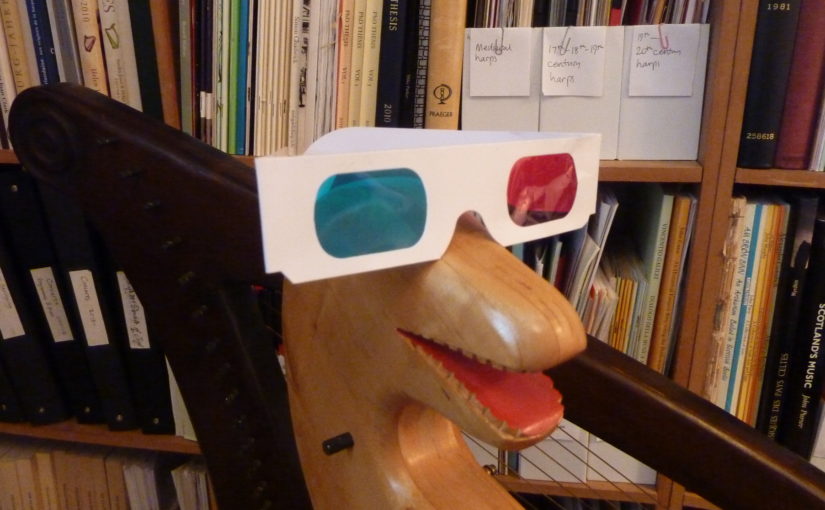
I had an idea to try and make stereo pair photographs of this part of the harp, to see if I could use them to measure the amount of movement both downwards (towards the bass end of the soundbox) and backwards (towards the back of the harp).

Continue reading 3d photography as a measurement tool

Irish harp finials: scrolls, figures and beasts

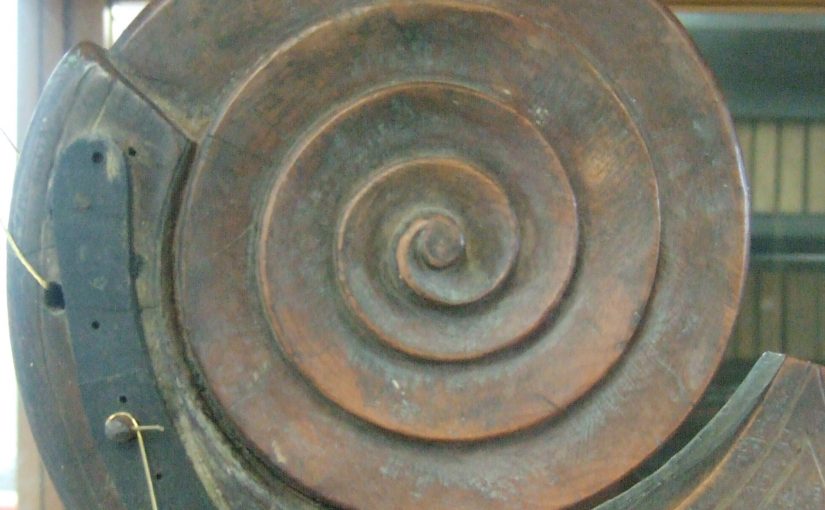
A discussion about the provenance of the Rose Mooney or Carolan harp which is owned by the National Museum of Ireland, prompted some thoughts about the decorative finial on the tops of the forepillars of the old Irish harps. I thought it might be interesting to line them all up to see if there were patterns or groups.

Continue reading Irish harp finials: scrolls, figures and beasts

harpers listening to bells

I was reviewing my interview with Mícheál Ó Catháin for forthcoming inclusion on his State of the Art interview series, and a comment on my upbringing in the English change-ringing tradition started me thinking about the potential soundscape of change-ringing in the ears of the old Irish harp tradition bearers.

Continue reading harpers listening to bells

Third time lucky

I started my blog on 17th May 2010. I shifted it to a WordPress site hosted at clarsach.scot on 4th October 2014. Now that I’m no longer based in Scotland I have let that domain go, and after some consideration, I decided to streamline things and move the blog and the archive onto my personal home page.

I still aim to post at least one thing a month – you will see from the archives that I failed this August due to my move to Armagh, and travelling to Kilkenny and Brittany.

My home page image is of my new business card. This is done as an homage to my grandfather whose business card forms the header to this post.

Thanks for reading this far and I hope to see you around here in the future as well!