
I was passing through the village of St Tugen, and so I stopped and looked into his church. It is a beautiful building, full of painted wooden sculpture. There was an information sheet that gave his life story, and there was a glass case with his relics.
news

Change of address
After 12½ years in St Andrews I have moved to Armagh – from the ancient ecclesiastical centre of Scotland, to the ancient ecclesiastical centre of Ireland.

Failte Mhic Mhuirich
I was in Edinburgh on 28th April 2018, to see the Lord Lyon King of Arms and one of his Unicorn Pursuviants presenting Dr. Robert Currie with his commission as Commander of the Name and Arms of Currie. Continue reading Failte Mhic Mhuirich
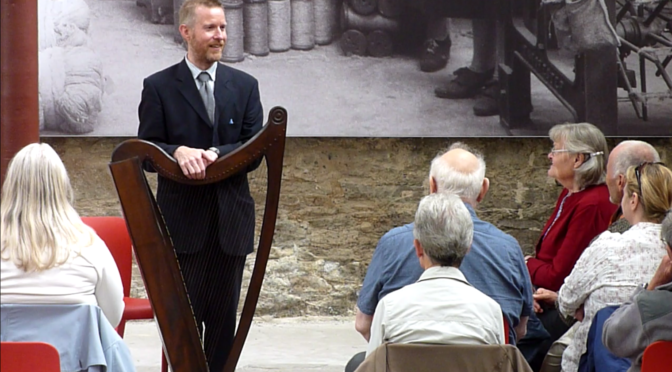
Ceòl mór at Verdant Works
Yesterday I was at Verdant Works in Dundee to play the lunchtime concert in their delightful “Music in the Mill” series. I played two big pibroch tunes, and I videoed one of them for you:

Talk and workshop at Galway Early Music Festival
Brenda Malloy sent along some photos of the talk and taster workshop last weekend. Thanks to Brenda for permission to put this one here!
Continue reading Talk and workshop at Galway Early Music Festival

Early Irish harp and modern Irish harp traditions
When I was preparing my talk for Galway Early Music Festival, I came up with a new handout which I gave to the participants and which we discussed in the talk and workshop session.
Continue reading Early Irish harp and modern Irish harp traditions
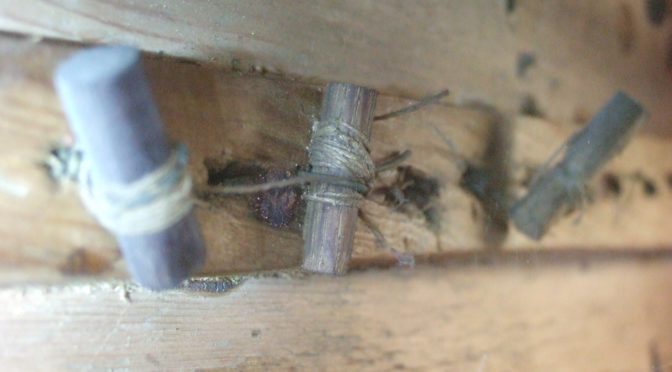
ursnaidhm ceangal – The pin or jack that fastens the wire of the harp
The word ursnaidhm (and variants) appears in Bunting’s 1840 book, where it is also translated “The wooden pegs to which the strings are fastened”. Today I was restringing my Student Downhill harp with only four gauges of wire, and I thought I would experiment with the toggle windings, following the historical evidence.
Continue reading ursnaidhm ceangal – The pin or jack that fastens the wire of the harp

Otway harp string holes
While working on something else I came across this from last year which I had meant to write up.
Understanding the tuning and stringing of an old harp requires knowledge of string lengths and angles. This basically means measuring between the tuning pin and the little hole in the soundboard where the string goes in. But Ann Heymann pointed out to me years ago that on the Castle Otway harp, you can’t see a lot of those holes, because the metal strap down the middle does not line up with the string holes in the wood.

Madame Scotia, Madam Scrap
I went to Glasgow to hear Helene Witcher talking about her book at the Aye Write literary festival. The book is a biography of Helene’s aunt, the Scottish harpist Heloise Russell-Fergusson.
Harpe bardique
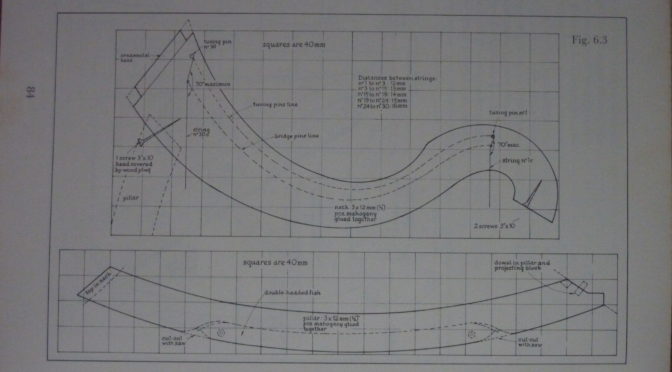
I have been discussing stringing possibilities of a harp made by a French harp maker, supposedly as a copy of one of the old Gaelic harps. Analysing its string lengths I noted that its scaling was suspiciously slow.
(Scaling is the technical word used to describe the ratio of string lengths across the range of a harp or other stringed instrument; a slow scaling means the strings increase in length more gradually as you move from treble to bass.)
Then I remembered that I had come across this slow, even scaling before, on harps modelled after the “Bardic harp” of Gildas Jaffrennou.