In 2018, I did a session at Scoil na gCláirseach in Kilkenny, about connecting to the old Irish harp tradition, and understanding how tradition worked. As part of that session, we sat with replica harps and looked at the portraits of the old harpers. I had not really prepared that aspect of the 2018 workshop, and so it was a bit ad-hoc. But afterwards, I realised that this was a very powerful tool for understanding and re-imagining the lost old Irish harp traditions.
Part of the point of that kind of work is acknowledging that the present day living practice of harp playing in Ireland is not part of the inherited indigenous Irish harping tradition. The inherited tradition came to a final end in the 19th century, with the death of the last tradition-bearers, who did not pass their tradition on to the next generation. Post-19th-century harp-players in Ireland have had to invent their practice anew, mostly by borrowing heavily from Anglo-Classical practice (many common features of present day practice, e.g. gut strings, semitone mechanisms, right orientation, harmonic arrangements, colour-coded strings, show Anglo-Continental classical lineage)
My idea was that we can try to re-connect to the broken end of the old Irish harp tradition by trying to imitate the last of the tradition-bearers. If the old harpers were still alive, we could sit beside them and copy their playing and share their tradition. We can’t do that because they’re all dead for over a hundred years; but we can try to imitate them as closely as possible by looking at what information we do have about their practice.
For some of the old harpers we have a huge amount of information. Patrick Quin is probably the most important; we have the amazing portrait discovered by Sylvia Crawford; we have the harp that he is playing in that portrait; and we have very explicit, clear and complete transcriptions live from his playing, done by Edward Bunting in around 1800. Denis O’Hampsey is also important, since we have the engraved portrait of him, we have the harp that he played, and we have Bunting’s transcriptions of his playing, though the portrait is less life-like and the transcriptions are more problematical. For other harpers, we have other information, less complete. For some we have transcriptions; for others we have harps that may or may not have been played by them; for some we have more biographical details.
But there is plenty enough to be getting on with, by applying ourselves in an honest and all-consuming attempt to play the old Irish harp by carefully and meticulously imitating the practice of the tradition-bearers.
The portraits, the old harps, and the manuscript transcriptions are our guidelines.
For Scoil 2019 this past August I led a participatory workshop titled “Replica harps & portraits of harpers as a source for performance practice”. The aim of this session was to explore what information the harps and portraits could give us. The portraits are simple enough, in that they show us posture and hand position (though there was some interesting discussion about the limitations of the portraits, and the different nature of the different portraits).
I spent more time talking about the old harps, and the value of really accurate “archaeological” reproductions of them, and what both the originals and the modern copies could tell us about how they were used in the old tradition.
The highlight for me was to have so many really top quality copies of a selection of the old harps lined up, and to have willing volunteers to sit in front of one of the portraits, and hold the appropriate replica harp, and try to copy the details of posture and hand position demonstrated by the old harper.
The video of the session is almost one hour long, but if you are interested in the process of trying to re-connect to the broken end of the old Irish harp tradition, you might find it of interest.
Thanks to Brian Doyle and ITMA for filming the session, and to Siobhán Armstrong and the Historical Harp Society of Ireland for hosting it. Thanks also to Michael Billinge and Aoibheann Devlin for the loan of their instruments.
The organiser, Lily Neill, had asked me to play some old Irish harp tunes to tie in with the music manuscripts and the early 19th century documents relating to the Irish Harp Society.
I took the new reconstruction copy of the NMI Carolan harp, which was delivered to me in Kilkenny by harpmaker Pedro Ferreira less than four weeks ago. So, this was the new harp’s first public engagement!
I played a couple of tunes I had found in the Collection, and some tunes associated with Irish Harp Society students Matthew Wall and Patrick Byrne.
Here is the full line-up for the day:
3:30pm-4:00pm Dr. Mary Louise O’Donnell – “The Bengal Subscription and the Irish-Indian Connection” Frank Bunting – “Edward Bunting’s Kilmore Parish Connections”
5:15pm-6:15pm Philip McDonagh – “Do you remember Sinclair Stevenson? Reflections on the Irish Missionary Tradition in India” Lily Neill – “The Emergence of the Lever Harp”
6:30pm-7:00pm Simon Chadwick – “The Old Irish Harp” Nicholas Carolan – “Some Irish Traditional Music Finds in the Beath Collection”
Mary Louise O’DonnellFrank BuntingPhilip McDonaghLily NeillMe with the new harpNicholas CarolanConference attendees discussing items from the Beath Collection on display
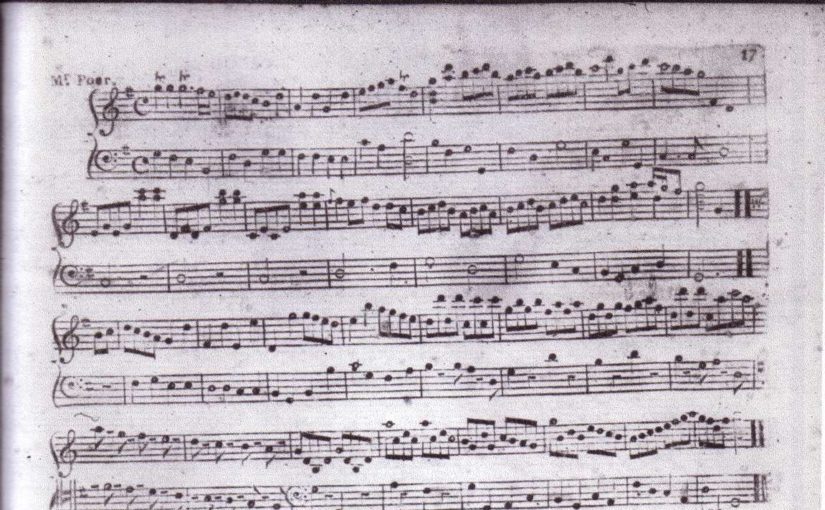
My header image shows a fragment of a manuscript which I played in my concert, from the Collection: Box 4, appendix 1, no.8
The Best harp is probably the worst of the surviving old Irish harps. It has been almost completely ignored in the literature. Joan Rimmer does not mention it; R.B. Armstrong does mention it but he failed to understand what it was, and he mis-identified it.
The Best harp was given to the Royal Irish Academy by the Rev. Berkeley Baxter, in 1882. The Wakeman catalogue of the RIA lists the harp as No. 369, and says that the harp was transferred to the Arts & Industry division of the National Museum of Ireland on 19th July 1958, under the reg. no. 93-1946. The harp is now at the National Museum with the accession number NMI DF:1946-93.
In the Freemans Journal of December 1882 there is an account of the provenance of the harp:
All that is known of it is, that a very old minstrel, some generations back, was frequently the guest of a clergyman of the name of Best, in the county Sligo, and that at his death the venerable minstrel bequeathed his harp to his worthy host, stating that it was an heirloom which had descended to him from his ancestors. Mr. Barter acquired the harp in 1879… from a lady, the descendent of the Rev. Mr. Best, and who is herself a distinguished harper.
Who was Rev. Best? At Michael Billinge’s index of old harps, it is suggested that he was the Rev. Best of Tandragee, County Armagh, mentioned by Andrew Craig in 1787, but this seems unlikely, since we know our Rev. Best was in County Sligo. I have not yet been able to find any more information about “Rev. Mr. Best of Sligo”. We might suppose that Rev. Best was dead by 1879 at the latest, so that his daughter, perhaps, had inherited the harp. Or he could have died decades before, and passed the harp down for many generations. So the “venerable minstrel” could have died any time before 1879. Not very helpful…
The account does, however, suggest that the harp may have been a genuine working instrument of a harper in the old tradition, and so I considered that it was worth studying, even though it is the worst of the old harps and is basically a horrible thing.
Neck
The frame of the Best harp is pretty horrible. The neck is perhaps the nicest part, carved fairly competently from a piece of very dark wood (the Freemans Journal says “ebony”, though I doubt this. Wakeman says it is “stained black” which I also doubt). But even then, there are two things about it that set it apart from the mainstream of old Irish harp norms. One is that it does not have the metal cheek-bands, which the tuning pins pass through; they seem never to have been a part of this harp. The other is that the curve of the tuning pins turns down in the treble, making the treble string lengths very badly scaled.
The bass end of the neck fits, as is usual, into the back of the forepillar. But the treble end of the neck, very unusually, fits into the front face of the soundbox. The only other old Irish harp I know of that does this is the Malahide / Kearney 2 harp, whose current location is unknown.
Right side of the neck, showing tuning pin drives 20 to 27Rough outline of the left side of the neck, with tuning pins numbered
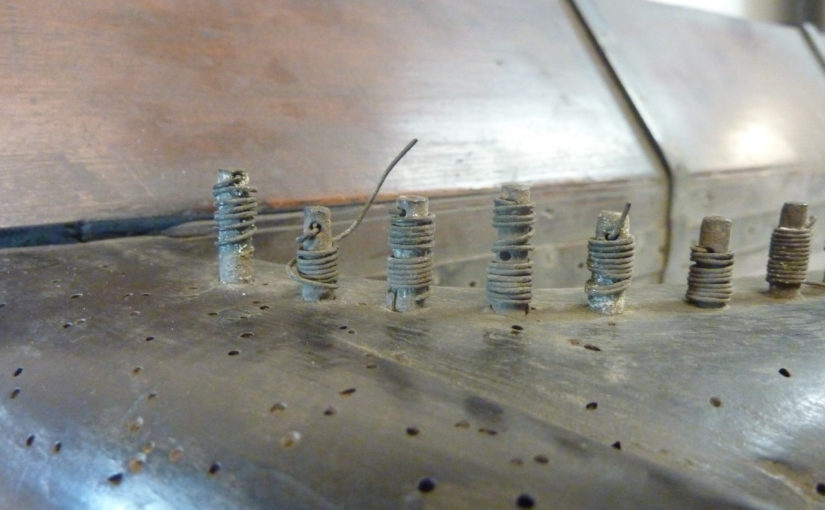
The neck has 35 tuning pins in it, Nos. 2, 4, 5, 9, 11, 12 and 34 are iron, and all the others are brass. Every pin except no.13 has the end of its string wound around it, though the free sounding part of each string has been removed. The pins are plain and undecorated and are not all identical, though they are nicely made of type 1a or 1b.
Soundbox
The soundbox of the Best harp is pretty crude, compared to the elegantly shaped and hollowed one-piece soundboxes of the other old Irish harps. Wakeman says it is “red sally” (i.e. willow). The soundbox of the Best harp is assembled from eight separate pieces of wood, having a five-sided cross-section. This is the same construction seen in the Malahide / Kearney 1 harp, where the front is formed from three planks, having a flat front and angled flanks. The soundbox of the Best harp is parallel in depth all the way along, though it appears to taper a little in width.
There are two sets of brass fittings on the Best harp soundbox. There are thin brass strips on the front: a long strip runs down the centre-line and has 36 string holes which line up with the holes in the wood. There are also three lateral strips which wrap across the front and are fixed onto the sides. The other fitting is the heavier brass plate with engraved lines at the top of the back of the soundbox.
Brass plate at the top centre of the back
There is an inscription on the bass end of the back, which seems to read IWI.
bottom centre of the back, with the letters I W I
There is no projecting foot on the soundbox; this is unusual on the old harps, with only the Clonalis Carolan harp similarly lacking a foot. The lower rear edge of the Best harp’s soundbox is very worn away, as if it had been played resting on that edge a lot.
Inside the soundbox, there are the ends of some of the strings. There are 10 strings and toggles still there. 8 of them are just the stubs, jammed into the string holes. Two are longer lengths, attached to the stringholes but with their toggles dangling inside the soundbox.
There are three different kinds of toggles. Strings 17, 19, 26 and 31 have wooden toggles. Strings 6 and 18 have iron screws attached as toggles. And strings 1, 2, 3 and 5 are toggled onto what look like toggle-knots that have broken from their strings and removed from their toggles.
Strings 17, 18 and 19 inside the soundbox. Note the scars around hole 16 where a wood-screw has been used on a string under tension.Strings 1, 2 and 3 inside the soundbox. The strings appear to be toggled onto broken toggle windings. Could these even have sustained the string tension if brought up to pitch? There are toggle-marks from previous use of wooden toggles in these positions.
Forepillar
The forepillar is the worst part of the Best harp. It looks like a broom handle painted black. It is straight, slender, and cylindrical all the way down, except for the ends where it squares off. It does not look strong enough to resist string tension, and it is so straight and slender that it looks ridiculous compared to the rest of the harp (even though the neck and pillar are hardly objects of great beauty and elegance). I wonder if it is a replacement for one that was broken or damaged.
Strings
The Freemans Journal article says that the harp “has 35 strings made of brass wire”; Wakeman says that “portions of wire strings remaining”. Now, the harp is basically unstrung, but the strings have been cut from the harp, leaving the coils wound around the tuning pins, and leaving some toggled ends inside the soundboard. Was this done after the Freemans Journal article? Or did the article interpolate from the fragments?
Were these string fragments the remnants of the last working stringing and setup of the harp? I think it is likely that all of the other old harps in the Museum that have strings on, have been restrung for display purposes since the harps became non-working collectables. So if we had a harp retaining its old stringing that would be very valuable.
I went to the Museum and I measured as much as I could manage by hand of the old strings. I think a lot more data could be extracted from this harp by using more high-tech methods, but this will do for a start.
All but one of the pins retains a winding of brass wire on it. Two of the pins have two windings, no. 18 perhaps being merely a single coil that has broken, but no.28 being very clearly a thinner coil that was a complete string, and a thicker bit of wire looped around the pin beneath it. All of the wires were wound clockwise around the pin end, to drop the string from the back of the pin. All of the windings were neat and close, not crossing, with the end inserted neatly into the drilled hole .
There were a few strings out of sequence, but the majority of the strings seem to be in the right place, and to increase from 0.7mm in the treble to 1.1mm in the bass.
I would summarise these measurements as saying the harp seems to be intended to have 0.75mm brass wire for the top 5 strings, 0.7mm for strings 6 to 16, about 0.9mm for 17 to 29, and 1.2mm for 30 to 35, with a few strings being the “wrong” size.
I also measured the string lengths. Because there are 35 tuning pins but 36 string holes, there are two possible configurations, 1-1 and 1-2. I measured both, but I think 1-1 is much more plausible. It is possible there was originally a 36th pin mounted on the forepillar, supposing the current stick is not original. The string lengths are a bit odd, with a few far-too-long strings in the treble (where the line of pins on the neck bends up then down), and with the mid-range and bass a lot shorter than an ideal (pythagorean) scaling.
This combination of having string lengths, and having wire gauges, allows us to plot a possible tuning regime for this harp. Unfortunately, the current stringing and setup of the Best harp seems to be as horrible as its design and construction. The use of 0.7mm brass wire in the treble means the treble strings are far too thick and far too high tension; the bizarre scaling of the harp means that the mid-range and bass strings are far too short and tubby.
The harp would speak with its lowest note at G (2 octaves below na comhluighe) and its highest note as e”’ one note higher than the top of the Downhill harp, at a slightly lower pitch than modern (perhaps a’=415). It wouldn’t go higher than that without snapping strings 4 and 5. At this tuning the total tension on the harp would be around 475kg which seems rather high for the slender neck and ridiculously slender forepillar.
If I were stringing and tuning a replica of this harp I think I would disregard the top five strings. Because of their bizarre toggles, I think they could be considered later cosmetic additions. Perhaps those top five should be thinner (the thinnest wire on the harp is no. 20, obviously out of place, measuring about 0.55mm). These top five could even be iron allowing a slightly higher pitch standard for the harp. And strings 5-6 is a good place to change gauge, being g-a on my suggested tuning.
So how do we regard the Best harp? Was it really strung and played in its current state by the “venerable minstrel” who visited the Rev. Mr. Best at his house in Sligo? If so, did this old harper know that he had the worst harp in Ireland?
How are we to assess the quality of an old harp? We are not in the tradition, we do not know what aspects of a harp are more or less important. It is easy to take a modern attitude, and to expect certain types of sound, touch, aesthetic and engineering criteria when we look at a harp. Perhaps the old harper who set up and played the Best harp thought it was fine, perhaps he was able to play it well to good effect. Perhaps he used the over-heavy treble and twangly bass for a specific traditional style of harp playing.
Or, was the harp a failed experiment by an incompetent harper trying to get a harp on the cheap from a local carpenter? Were the strings put on it after the harper died and bequeathed it, just using whatever wire was left over in his string-bag, to try and make it look presentable for display in the entrance hall of the Best residence? What did Rev. Best’s descendent, the “distinguished harper”, who passed it on to Berkley Baxter, think of it? Did she try to play it? Was she glad to get rid of it?
There is a story behind every artefact, a sequence of human interactions that layer upon layer shape and affect the material object. Every aspect of the Best harp has been done by Human agency. Someone has wound those strings on, someone has snipped them off. Someone has wound string 28 with a fat bit of wire jangling round the tuning pin shaft. Someone has wound the toggles and the wood screws and the strange loops in the treble. Who? Why? What were they even thinking? We cannot know, but we can analyse the stuff they left behind to try and work some of it out.
Thanks to Sarah Nolan and to the National Museum of Ireland for facilitating my visit.
Carolan’s tunes had no base to them originally, as we have been informed by the late Keane Fitzgerald, a native of Ireland, and a good judge of music, who had often seen and heard old Carolan perform. It was only after his decease, in 1738, that his tunes were collected and set for the harpsichord, violin, and German flute, with a base, Dublin, folio, by his son, who published them in London by subscription, in 1747.
Abraham Rees, The Cyclopaedia; or, universal dictionary of arts, sciences and literature. London: Longman, Hurst, Rees, Orme & Brown, 1819. Volume 17, (unpaginated, under ‘Harp’)
From the Minute Book of the Irish Harp Society, Belfast, some time in the first few months of 1810:
The Committee proceeded to an investigation of certain charges made by Arthur O Neill our Harper against Bridget O Reilly and Edward McBride two of our Scholars for having an Improper Connection. They were unanimously of opinion that such charges have been altogether groundless, false and unfounded
Belfast, Linen Hall Library, Beath Collection, box 5, item 1
(the previous page is dated 6th Feb 1810; this may be from that meeting or may be from an subsequent undated meeting. The entry is followed by a few blank pages and then the next item, in a different hand, is dated 8th May 1810.)
Bridget O’Reilly was from Virginia, County Cavan. She was a student of the Irish Harp Society school starting in September 1809.
Edward McBride was born around 1792. He was from from Omagh. He was a student at the Irish Harp Society starting in November 1808. When the Irish Harp Society was re-formed in 1819, McBride was recruited to be the new master and teacher of the school; one of his students then was Patrick Byrne.
Donal O’Sullivan’s book, Carolan: The life times and music of an Irish harper was published in two volumes in 1958. It presented a biography, and 213 tunes presented as corrected typset melody lines, and also with quite detailed notes on each tune including some lyrics. This book has defined Carolan studies ever since, and the book has been reissued a couple of times, and there have also been derivative works.
I think there are a number of big problems with this book, which have never been addressed to my knowledge. One is that Donal O’Sullivan’s edited versions of the melody have become used as sources for performance, even though many of them are arbitrarily changed from the early source versions. Another problem is that O’Sullivan relied heavily on late fiddle and pipe sources, rather than respecting earlier harp transcriptions. Thus he also ignored harp idiom in the early sources including key, basses and ornamentation.
He also was very hasty to associate titles, lyrics and melodies, sometimes making demonstrable errors. He also included every tune he could find that had even the slightest hint of an association with Carolan, only marking the most unlikely with an asterisk to show their doubtful status. This system has been continued in the 2001 Ossian re-issue of O’Sullivan’s book, which includes new material not available to O’Sullivan. Catríona Rowsome’s 2011 book uncritically accepts all of O’Sullivan’s suggestions and the 2001 additions, giving a corpus of 226 tunes.
To Donal O’Sullivan’s credit, he did include references for all of his source material. However his referencing system is very tricky to use, with sources given by index letters, requiring constant cross-checking between pages and volumes. Also, many of his sources are still not easily available in facsimile.
You can use the spreadsheet to sort by source, or by Donal O’Sullivan’s number. I have also put a tentative rating beside each tune, to show how likely I think that Carolan had anything to do with the tune. These can be edited later if new information comes to light.
Rather shockingly, only a bit over half of the tunes have a solid and reliable attribution to Carolan; about 1/4 are almost certainly spurious.
There’s a lot more work to be done on this, and in time I will update the spreadsheet. But I thought it was in a useful enough state at the moment to show it to you,
I’m being slow at organising my data, but today I managed to re-sample the NMI Carolan harp laser-scan, and uploaded it to Sketchfab. This allows it to be easily embedded in web pages.
Sketchfab does allow downloading of the low-res model but I have also made a link to the full-res version: OBJ mesh file. I use the MeshLab app to view and manipulate the OBJ mesh file
The scan data is marked cc-by (attribution) on Sketchfab but I think it is really public domain, since it is just a digital reproduction of a public-domain publicly owned artefact. You don’t need to attribute it to me – please give attribution and credit to the National Museum of Ireland, who own the original object and gave permission for the laser-scan to be made.
Here’s the video of Elaina Sugrue of Accuscan, making the scan back in the October 2018. You can see how the point-cloud, captured by the scanner, is rendered real-time on her laptop screen. This scanning process generates a huge amount of point data, which had to be processed, and separate passes with the scanner “registered”, to generate the finished mesh file.
I think it is important to be able to release this kind of primary data, as part of the project to understand the old harps more. This scan is a wonderful resource, but it needs a lot of further study to be of practical use. I have made many slices and renderings, which in due course I will publish.
This harp, being very damaged and distorted, requires also a lot of theoretical reconstruction work. Hopefully in time we can also publish reconstruction drawings. I am still thinking about how best to go about this.
I remembered my old post, Archaeological copies of old Gaelic harps from back in 2016. We are not moving at the rate I suggested of one per year, but this kind of study and documentation is an important part of this kind of long project.
The header photo is by Brenda Malloy, and shows myself and Elaina Sugrue at the National Museum of Ireland in October 2018
There are a number of different styles of taper harp tuning pins. I am trying to categorise them so that it is easier to be specific when talking about the different types. Up to now I have talked about the “old” style with fat drive heads, and the “modern machine-made” style with narrow heads. But I see now that these are rough categories, which can be broken down more subtly.
I think the most distinctive and diagnostic thing is the relationship between the drive and the shaft. The drive is the square- or rectangular-section end of the pin, which is where you put the tuning key on, to turn the pin. The shaft is the conical main part of the pin, which is embedded in the wood of the neck, and also which carries the string at the far end. The shaft is always, and the drive usually, tapered rather than parallel-sided.
Basically I think the first diagnostic is whether the head is wider or narrower than the shaft; in other words whether there is a step up or a step down to the head from the shaft.
I’d suggest Type 1 pins have a step up from the shaft to the head; Type 2 pins have the head about the same size as the shaft, and Type 3 pins have a step down from the shaft to the head.
We could have sub-categories; sub-type a could have a sharp step at about 90°; sub-type b could have a clear transition at about 45°; and sub-type c could have a very smooth flat transition. We could also append R for pins with rectangular (not square) drives.
Suggested typology of harp taper tuning pins
Because both head and shaft taper away from the centre of the pin, and because there is often a gradual transition from shaft to head, it can be hard to state at what point the diameter or width of each part should be measured and compared. So while it is easy to think about comparing the width of the head with the width of the shaft, it is often difficult in practice to choose where to measure. So my idea of looking for the nature of the “step” between shaft and head might prove more useful.
Left to right: Type 3a (modern #5×3″ steel pin) Type 3a (modern #4×3″ steel pin) Type 3b (steel pin from Arnold Dolmetsch harp no.10, c.1932) Type 2c (iron pin made by Simon Chadwick for a replica medieval Gothic harp, 2018) Type 2cR (iron pin made by Simon Chadwick for the replica Queen Mary harp, 2014) Type 2cR (brass pin made by Simon Chadwick for the replica Queen Mary harp, 2007) Type 1b (brass pin made by Simon Chadwick for the replica Carolan harp, 2019) Type 1c (brass pin from county Monaghan, c.17th century)
I think that previous attempts to document tuning pins have not been specific enough about where the measurements have been taken. The scheme below suggests where to measure:
Point A is the extreme end of the pin B is the smallest diameter of the conical shaft of the pin C is the largest diameter of the conical shaft of the pin D is the largest width across the flats of the drive E is the smallest width across the flats of the drive F is the extreme end of the pin.
The following measurements can be taken to record a pin: 1. Distance A-B 2. Diameter at B 3. Distance A-C 4. Diameter at C 5. Distance A-D 6. Width across flats at D 7. Depth across flats at D 8. Distance A-E 9. Width across flats at E 10. Depth across flats at E 11. Distance A-F
From these measurements we can calculate the taper of the shaft, the range of sizes of tuning key socket which will fit the head, and the nearest standard taper hole that the pin will fit in. We can also work out the nearest standard taper blank to use for making a copy.
I’ve been working in a lot of libraries recently. I love seeing inside different library buildings – the ambience and atmosphere and architecture sometimes seem as important as the collections.
Armagh Public Library was set up by an act of parliament which stated that it would always be called the Public Library, but they changed its name recently and it is now called the Robinson library after its founder, Archbishop Robinson. It is a handsome 18th century classical building stuffed full of handsome 18th century leather-bound volumes. This is the most elegant and beautiful library but is the hardest to make practical use of because its collections are so old-fashioned! I did check out their copy of the Memoirs of the Marquis of Clanricarde, to understand more the preface which famously mentions the performance of bardic poetry with harp accompaniment.
I had previously seen a copy of this book at Luggala. I remember somewhere reading an opinion that Garech Browne’s was the finest private library in Ireland, but I never managed to get to see inside – there was always some excuse, or distraction.
In contrast, the Irish and Local Studies library in Armagh is hidden round the back of a council building, entered through a basement door at the back of a car park. It has excellent collections of journals and newspapers – I never even got to go into the rooms with books! I found some very interesting references in very obscure 19th century periodicals here.
In Dublin I have been working at the National Library of Ireland, and also at the Royal Irish Academy. Both have beautiful buildings, and excellent collections; I have mostly been looking at specific unique items there. I have especially been reading the RIA minute books from the 19th century – I have not found what I am looking for in them, but that in itself is kind of interesting. They are really fascinating objects, full of the signatures of the Great Men like Petrie and Wilde. I have more references to follow up especially at the NLI, but it is harder to do because they are not so easy to get to.
In Belfast I have been using the Linen Hall Library and the McClay Library at Queens University Belfast. The Linen Hall library is a lovely old building full of lovely old collections, while the McClay is a really impressive new building with a tower that reminds me a little of Cambridge University library. The McClay holds the Queen’s Special Collections, including the Bunting manuscripts, and so has been extremely useful for me.
A library I have been involved with creating for over a decade now is that of the Historical Harp Society of Ireland; this library unfortunately remains merely a collection of books, since it has no librarian and no building. Maybe in time that will change.
There are other libraries which I would like to get access to. Another private library I have been in, but not used, is that at Clonalis House. There is Marsh’s Library in Dublin. And there is the curious local studies library at Benburb – it was closed when I visited, but I should try again.