
As part of my Old Irish Harp Tunes Transcriptions Project, I have been looking at where and when Bunting collected tunes. My interactive map shows the dates and places he tells us he was collecting.
Continue reading Bunting’s collecting tripsnews
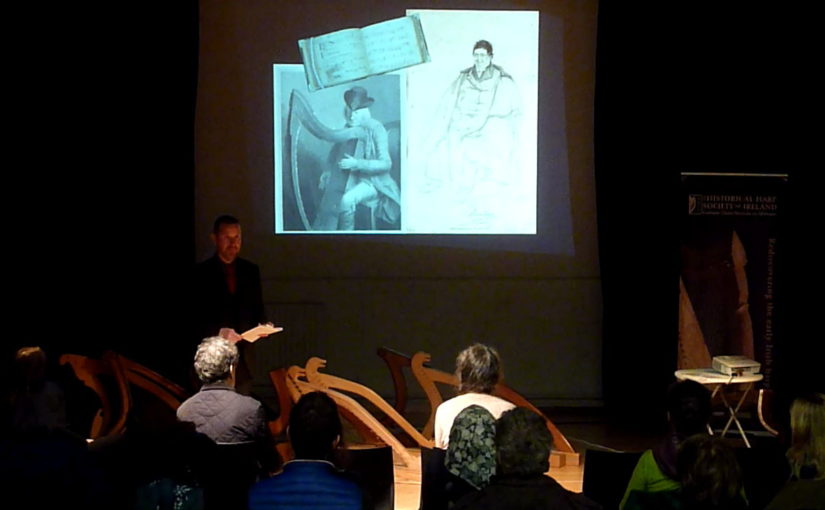
Trying to describe the process
On Saturday I presented a talk in Belfast, at the Cultúrlann McAdam Ó Fiaich as part of the HHSI Discovery Day events within the Remembering Bunting Festival.
Continue reading Trying to describe the process
Bunting tune collecting statistics
As I work on the transcriptions project I am also assembling a spreadsheet of tunes and metadata to try and get a grip on attributions, variants, and titles.
Continue reading Bunting tune collecting statistics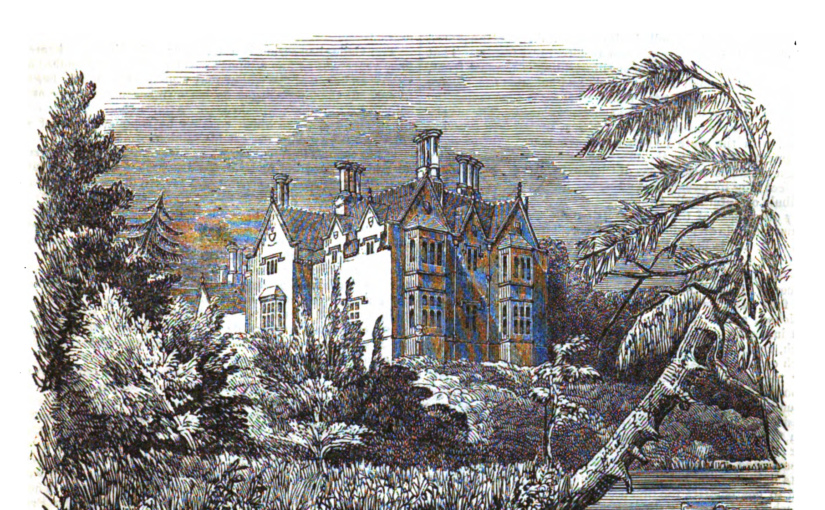
Robin Adair
Last week I was working with Karen Loomis, for the Historical Harp Society of Ireland, in the National Museum of Ireland, studying the Hollybrook harp (NMI DF:1986.2). The harp was purchased by the Museum at Sotheby’s in 1986. The auction catalogues and museum archives do not have any more information about the provenance before it was sent to auction.
The Hollybrook harp was described and illustrated by Robert Bruce Armstrong in 1904. He says it belonged to Robin Adair at Hollybrook. I am trying to unpick the rather confused information about these people and places. I am sure there is a lot more fine detail to uncover about the life of Robin Adair and the places he lived and visited, and his friends and associates, but this will do for a start.
Continue reading Robin Adair
Old Irish harp transcriptions project
I first got hold of a facsimile of Bunting ms29 (Queens University Belfast, Special Collections, MS4/29) when it was first published online at QUB Library web site, back in 2006, and I have been working from the facsimile ever since.
Continue reading Old Irish harp transcriptions project
Last Days at Luggala
Garech Browne asked me to come to Luggala two-and-a-half years ago, when Richard Curson Smith and Liam McGrath were filming some scenes for a proposed documentary about Garech. Some of their footage has now been used in a new film, commissioned by RTÉ and directed by Mick Mahon, which was first broadcast last Wednesday.
I knew that playing for this kind of film means the footage will be used in tiny fragments, so I decided to play a sweet simple melody – the tune “Luggala” seemed most appropriate. Garech said afterwards that he was disappointed, he had hoped I would play ceòl mór. Garech was particularly taken with the idea of ceòl mór or pibroch played on the harp; he told me that he had read the idea in William Matheson’s book The Traditional and National Music of Scotland. The previous year, I had played pieces of ceòl mór on the harp for him and a few of his closest friends; he had wept openly, and said he never thought he would live to hear it.
The new film is a very beautiful thing, capturing Garech’s character very well. It is visually stunning of course, thanks to the setting at Luggala, but the memories of Garech’s friends in the documentary are lovely as well.
The film is available on the RTÉ Player until the middle of January. Watch it if you can!

Harp case part 1
From a practical point of view, seeing as how the case doesn’t affect the musical possibilities or performance of the instrument, there is no reason not to use the best case you can. In the past I have ordered cases from Glenn Cronkhite in California; his cases are extremely well designed and well made. I have three. But he has retired, and production has stopped.
There is also a legitimate research question about how harps were protected and transported historically. From a practice-based-research point of view we might want to experiment with using a reproduction historical case, to find out how well it protects the harp, and how it constrains or enables different performance contexts. Also, from a research-based-practice point of view, we might enjoy and even benefit from using a case made following historical models.
It’s curious that we seem to know more about harp bags, the further back in time we look. Some of the early medieval Germanic lyres even retain fragments of actual bags adhering to the decayed remains. Martin van Schaik wrote an interesting paper ‘The harp bag in the middle ages’, published in Aspects of the Historical Harp (1994) which discussed illustrations of harp bags as well as Irish and Scottish literary mentions.
Peter Holman, ‘The harp in Stuart England’, Early Music XV 2, May 1987, draws attention to a bill written out by the harper Cormack MacDermott:

Itm for putinge of a newe backe to yro Loxs. harpe
and mending of it wth plate where it was broken
and cutinge /the necke shorter ——————————– xvi sfor a lether case wth a chine and lynde wth
cotton for yor Lox: harpe ———————————– xxx sReceived by me Cormack dermode
Tristram Robson, in his thesis The Irish harp in art music (1997) adds that the bill is endorsed on the back: “item 46 shillings, Cormacke, bill of the 20th May, 1607”.
I was curious about the word “chine”. I suppose it might be read as “chire” or some other word but I think “chine” is the most plausible reading. Chine is not a very common English word; I know it from my youth as a kind of unstable steep-sided ravine; and also for the sharp angle along the side of certain types of boat hulls. I note that other meanings focus on the ridge (rather than groove) meaning and so I wonder if Cormack’s case had some kind of ridge? I have not found references to chines in specific leather-working contexts.
The other thing of interest in Cormack’s bill is the case being lined with cotton. I would expect something like this to have been lined with linen instead; it was not until the Restoration in the 1660s that cotton Calico and Chintz were introduced to the English market. A common type of fabric before then, back to medieval times, was fustian, which is a cotton-linen blend. But would Cormack have itemised a fustian lining as “cotton”? Another possibility is that the “lining” was actually a padded stuffing of cotton-wool.
Making tuning pins
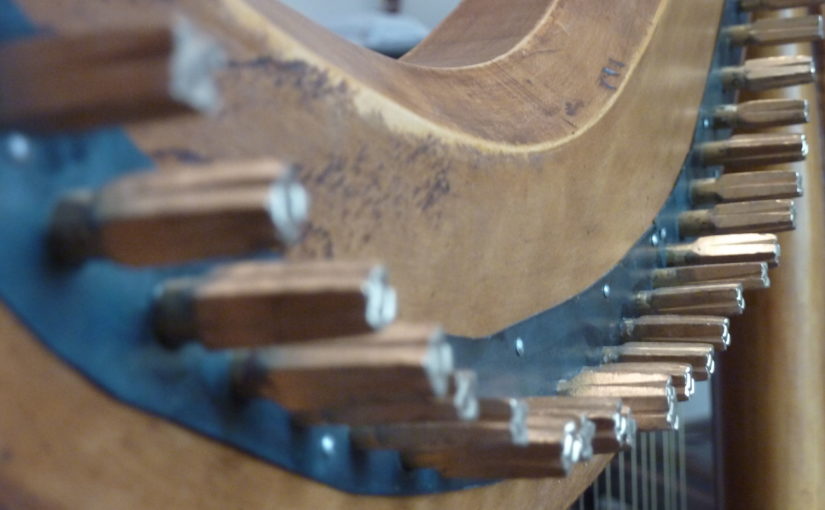
This post describes my method of making tuning pins. It is a labour-intensive process and though I am taking orders for sets of pins, I think my pricing does not really cover the work involved. But I want there to be more harps with beautiful handmade pins! I’m posting this so that if anyone else wants to take on the manufacture and supply of pins like this, they can get some ideas from what I have worked out.
Design
I want my pins to be the same as the old Irish harp pins. This is harder than it sounds because it is very difficult to accurately measure the old pins. I have been studying a combination of photographs of the old pins, and accurately calibrated laser-scans. The problem with the laser-scans is that there are a lot of scanning artefacts on the tuning pins; the problem with photographs is that perspective and parallax makes the tapers and exact sizes very difficult to assess.
For the reconstruction copy of the NMI Carolan harp, I chose one of the pins and made a paper template full-size from the laser-scan. I am also interested in copying some of the archaeological pins such as the ones from Montgomery Castle. It is also possible to come up with a kind of generic design pin that is not an exact copy of any one old pin, but which fits into the general scheme.

I also tried making resin casts of the Monaghan pin, but this is not a particularly good pin since the shaft is not parallel and circular. Even then it was very hard to accurately measure its size.
I think that for functioning pins we need to control the taper and diameter of the shaft, and we need to control the taper and width of the drive. I am doing this by using commercial standard tapered shafts, and then hand-shaping the heads to fit with standard sized gauges.
Shafts
I’ve been using Dan Speer‘s brass shafts. I haven’t yet found a supplier in the EU; but Dan is efficient and friendly to deal with. I also ask Dan to drill the string hole for me. I ask him to make the hole a bit smaller than usual, and closer to the end. The blanks are expensive, and so is shipping and import duty.
I have been experimenting with different size blanks. They are sized according to the Imperial taper system, with a 1/48 taper. The blanks are specified by a length and a number; the number refers to the diameter of the large end of the pin. This means that the longer the pin, the smaller the small end is. Sometimes I cut the wide end of the head off to make the blank shorter; this of course makes the whole pin more slender than if I had used a shorter pin of the same number.

Heads
For the heads, I buy square-section brass rod. This is available in standard sizes. The rod needs to be at least as wide as the wide end of the shaft; so for no.4 shafts I would buy 1/4″ (6.4mm) square rod. If I am using no.5 pins, then I need to get the next size up which is typically 3/8″ (9.5mm). Ideally the rod should be about the same size, so for no.5 pins the rod should be 7.5mm, because anything bigger than that will just need filed away.

Assembling heads and shafts
The head is cut from the square rod with a hacksaw. For consistency, I use a caliper / divider to mark the length of the head.
The shaft can be used as is, or can be cut down. I started making my pins using the blanks as is, and then I realised that this made my pins a bit thicker than modern machined harp pins of the same nominal size. That’s because I was adding the head to the wide end of my pin, whereas a modern machine-made pin cuts the head down into the wide end of the blank. So, my preference now is to cut a short length off of the wide end of the pin.

In the example from my notebook, I would cut the head from 1/4″ square brass rod, cutting a piece 18mm long. I would take a pin blank, #4 x 3 1/2″ (i.e. no.4 x 89mm). I would mark 75mm from the small end, and cut off the remainder of the fat end.
Then I would carefully file the cut ends flat, so that they would fit together closely.
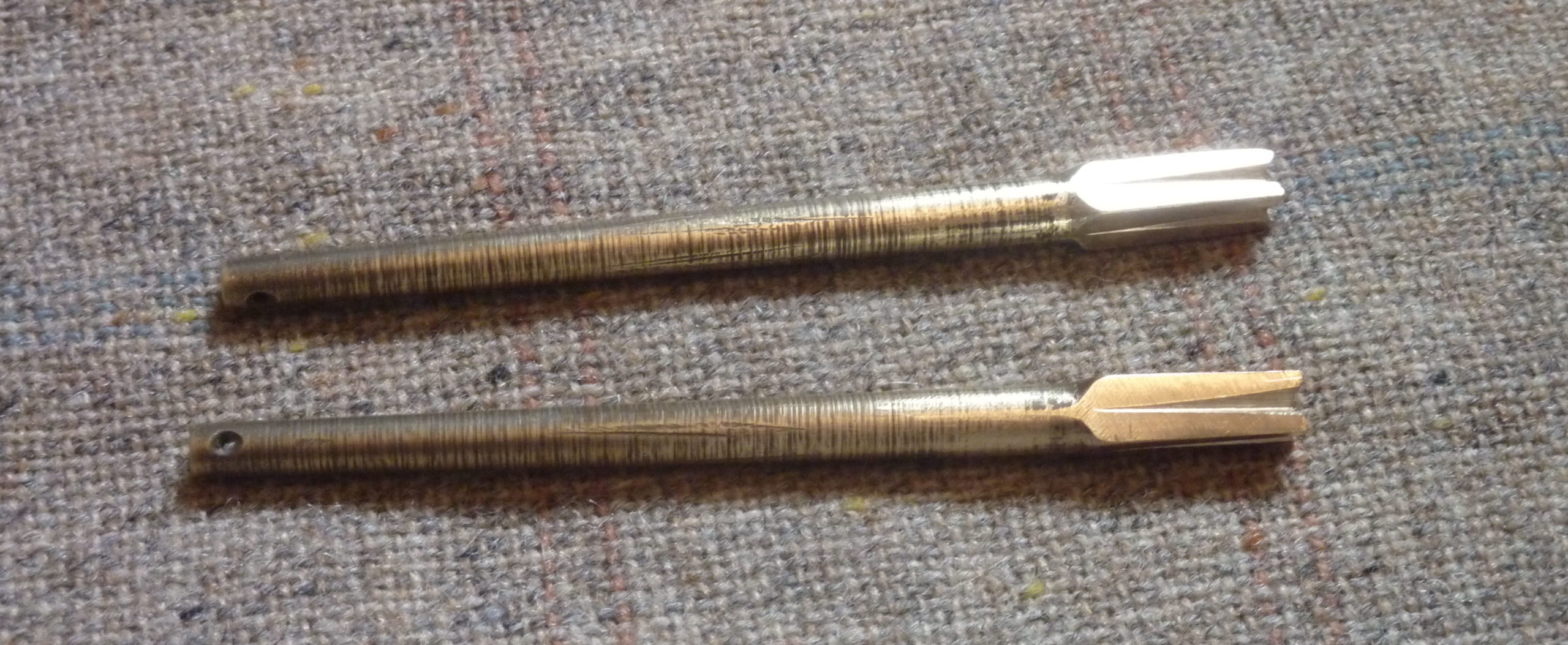
I use a blowtorch and silver-solder to join the shaft and the drive. This is tricky and precision work. I use firebricks to hold the pieces together under their own weight, standing the shaft wide-end-down on top of the head, with just a nice amount of flux powder. When they are almost red-hot the solder can be touched to the joint to melt in, and then more heating will bring the brass to red-hot and the solder will flow throughout the join and make nice wide fillets at the four corners of the head.


Then the heads are filed. Care is needed to make the inner, wider end of the head just flush with the shaft; the outer, narrower end is tapered gradually down.
I use standard clock-keys as measuring gauges to judge the taper of the heads; for the example no.4 pins my notebook indicates how far onto the tapered head two clock keys will fit; a no.13 (5.5mm) key will fit about halfway down the drive, and a no.12 (5.25mm) key will fit just a few mm down the end of the head. I think I would use a 5.75mm socket on a tuning key for these pins.

Finally, the V-shaped grooves on the drive are made, with fine needle files. Different original pins have different configurations of these decorative grooves; their specific shape and depth gives a lot of the character to the pins. For these no.4 pins I made the grooves on the drive faces very deep and tapering; the diamonds on the drive ends were also cut very deep and then shaped to give a “clove” effect. Other pins I have made have much shallower grooves which give a more two-dimensional look, more like engraved lines. Some pins also have lateral incised lines running around the drive end.
I don’t believe this is how the old craftsmen made brass tuning pins. I think it is much more likely that the old pins were cast and/or turned on a lathe. I have seen modern cast and turned copies of the old pins, and they look very nice. But I don’t have either foundry equipment, nor a lathe. Also it seemed important to me to fit in with modern norms and to use the modern 1/48 Imperial taper shafts, just like other harps.
My header image shows the pins I made for the reconstruction copy of the NMI Carolan harp, which was made for me by Pedro Ferreira.

A little history
I have been asked to do a historical overview talk at almost every Scoil na gCláirseach for years and years. Every time I do it, I try to make it new and fresh, to basically come up with a new overview. I think that way, I challenge myself to think about what story I want to tell, what are the important strands that we want to focus on.
Here’s my August 2019 talk, videoed by the Irish Traditional Music Archive.
I only had half an hour allocated, which made me focus even more. In this talk I didn’t speak about the modern revivals; sometimes I would make these an important part of the story. But somehow the medieval museum ambience made this aspect seem less important. And for the week-long participants at the summer school, the revival was what we talked about each day.
I’m always interested in the questions and comments….

Using medieval harps to reconnect to 19th century tradition
As the old tradition came to an end in the first years of the 19th century, the old harpers who were the tradition bearers seem to have played harps that were made in the first half of the 18th century. Denis O’Hampsey died in 1807; his harp was made in 1702. Patrick Quin was still alive in 1811; his harp is dated 1707 though some people argue that it is much older. The last dated instrument in the old tradition I know of is the Bunworth harp, made in 1734. There are later references to harps being made; Arthur O’Neill talks about going to the harpmaker Conor O’Kelly to oversee the completion of an instrument, which would have been after about 1750. And William Carr, who was by far the youngest of that last generation of tradition bearers, mentions having a rather poor quality harp made for him by a carpenter, apparently in the late 1790s.
All of the harps we know about that were played in the continuing tradition at the end of the 18th century and into the 19th century were large, mostly high-headed instruments. We don’t actually know what kind of harps were used by the first generation of revival students taught by Arthur O’Neill in the early 19th century; but the second generation of charity school students from 1819 on played on the big wire-strung ‘hybrid’ Irish harps made for the Belfast Harp Society by John Egan. Some of these students continued playing their big ‘hybrid’ harps down to the 1880s.
Yet the wire-strung harps made for revival purposes from the 1890s onwards don’t look back to Egan’s hybrid wire-strung harps, and they don’t even look back to the 18th century harps played by the last of the tradition-bearers. Instead, the models were the medieval Trinity College harp and the Queen Mary harp.
I really noticed this in May when I was gathering images for my Discovery Day talk. The centrepiece of the talk was our current method for re-connecting to the end of the tradition, by getting a replica of Quin’s or O’Hampsey’s harp, studying posture and hand position from Quin’s or O’Hampsey’s portrait, and working through the field transcriptions of Quin’s and O’Hampsey’s playing.
But the images of revivalists from the 1890s to the 1970s all showed small medieval harps.

Equally interesting is the way these harps were used. The slide of the Glen harp is revealing, showing Kate MacDonald playing with the harp on her right shoulder, and held very high, in a classical style and technique.

The Dolmetsch harp is shown with a photo of Edith Taylor; though we know she played left-hand-treble in the old style, what I have found about her music suggests she was playing classical-style arrangements of the “songs of the Hebrides”. Mabel Dolmetsch used one of these medieval style Irish harps to play tunes from Bunting’s piano arrangements in the 1930s.
Chris Warren’s picture is especially interesting. He was explicitly working to re-connect to the end of the tradition in the 1790s and early 1800s; he worked on the “harp music in the Bunting collection”, but he used a copy of the medieval Trinity College harp.
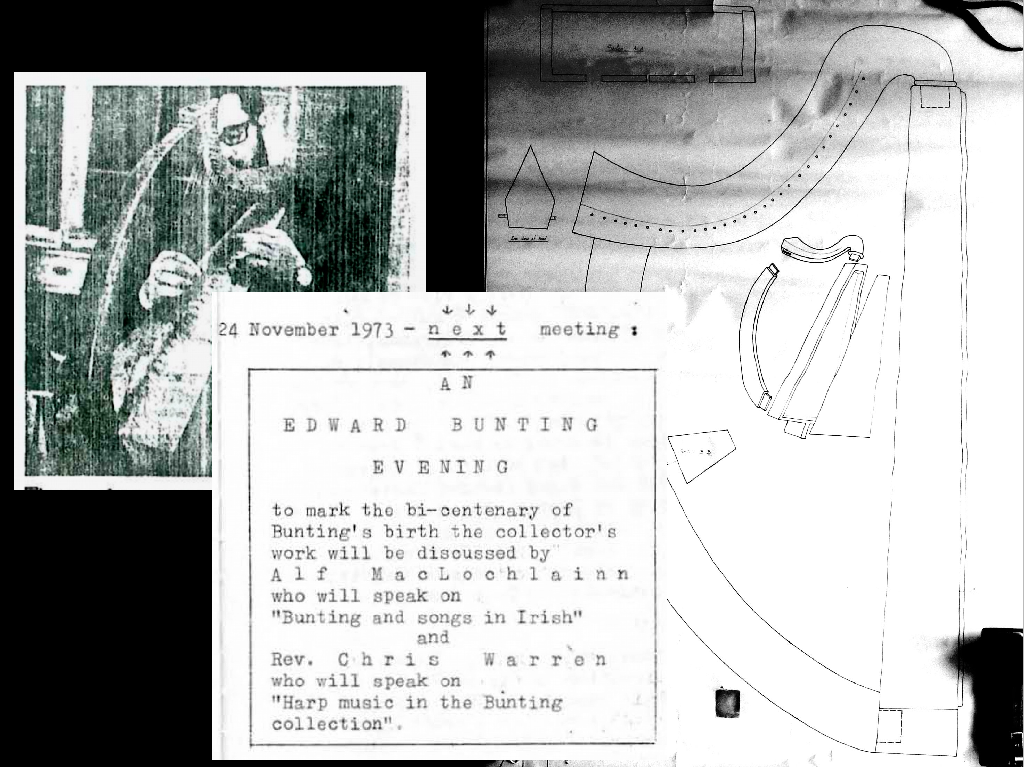
It was only with Ann Heymann in the later 1970s that we saw someone getting a copy of first Quin’s harp, and then O’Hampsey’s harp, and studying Bunting’s manuscripts with the transcriptions of the old harpers’ playing.
What is going on here? I think this is connected to the harp as symbol, vs. the harp as working instrument. The Trinity College harp as the national symbol, gave it a much stronger resonance, than the 18th century harps as the working instruments of the last tradition-bearers 200 years ago.
We need to do more research on this, to find out if anyone else was taking the big 18th century style harps seriously before Ann; and to correlate better the playing style, idiom, repertory and instrument choices of different revivalists over the past century or more.