
I made a demonstration video of A chailíní, an bhfaca sibh Seoirse, played (with some editorial adjustments) from Edward Bunting’s live transcription from old Irish harp performance in the 1790s.
news
Tá Mé Mo Chodladh, from Hugh Higgins in 1792
I made a demonstration video of Tá Mé Mo Chodladh, from Edward Bunting’s live field transcription of the playing of old Irish harper Hugh Higgins in 1792.

Toby Peyton
I made a demonstration video of Planxty Toby Peyton, from Edward Bunting’s live field transcription of the playing of an old Irish harper in the 1790s.

Broderip & Wilkinson, the Compositions of Carolan
One of the source books used by Donal O’Sullivan for his Carolan in 1958 is the enthusiastically titled A Favourite Collection of the so much admired old Irish Tunes, the original and genuine compositions of Carolan, the celebrated Irish Bard. Set for the harpsichord, violin, and German-flute, published by John Lee in Dublin. There is no date on this book, and O’Sullivan suggests 1780.
Continue reading Broderip & Wilkinson, the Compositions of Carolan
Seabhac na hÉirne, or the Hawk of Ballyshannon
I was very pleased to discover what seems to be a traditional sung version of a Carolan song.
Continue reading Seabhac na hÉirne, or the Hawk of Ballyshannon
Edward Dodwell
Edward Dodwell is another of the tunes in the “difficult” section of Edward Bunting’s field notebook between pages 14-40. You can see in my tune list spreadsheet that Ned Dodwell, on p.40, is at the very end of that section. In fact, since the next facing page from p.40 is p.43, I think we are missing a page here, and I think the missing page had a neat copy of Ned Dodwell.
Continue reading Edward Dodwell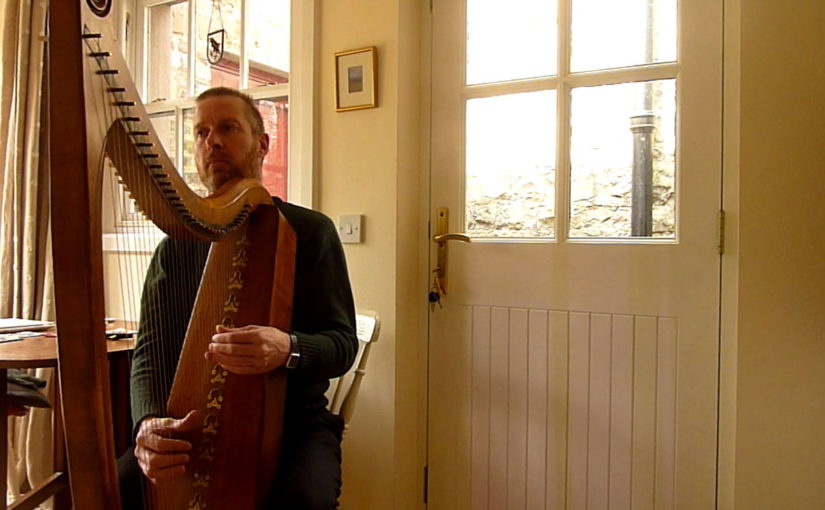
Diarmaid Ó Dúda
I made a demonstration video of Diarmaid Ó Dúda (DOSB 37) based on the live field transcription written down by Edward Bunting in the 1790s.
The incredible shrinking harp
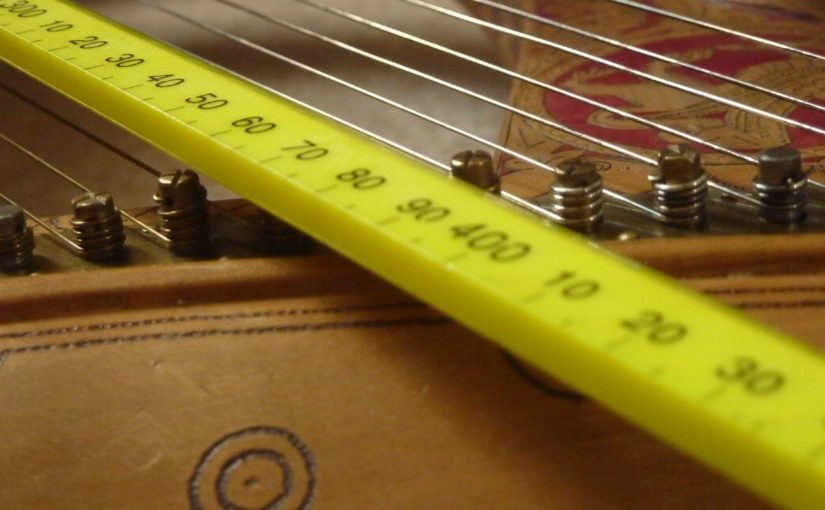
When my replica of the Queen Mary harp was new, Keith Sanger suggested to me that I should measure it repeatedly over time, to see if and how much it changed shape and size over the years.
The idea is to get some idea of how reliable the measurements we take of the old harps in the museums are, and how much the old harps might have changed shape from when they were new to how we see them now.
Continue reading The incredible shrinking harp
Mrs. Anne MacDermot Roe
Edward Bunting made what looks like a live field transcription of a tune titled “Mrs McDermottroe” or “Nanny O Donnely” on p. 18/18/27/f8v of Queen’s University Belfast, Special Collections MS4.29. Bunting made an edited neat copy on the facing page, and he published a piano arrangement in his 1797 book (No.53, Anna ni ciarmuda ruaidh / Nanny McDermotroe / Carolan). There don’t appear to be any independent variants of this tune, so the only way to understand it is to analyse Bunting’s very unsatisfactory notations.
Continue reading Mrs. Anne MacDermot Roe
Planxty Drury
I made a demonstration recording of Planxty Drury (DOSB 10) (DOSC 42) based on the live field transcription written down by Edward Bunting in the 1790s, from the performance of an old Irish harper.