
Edward Bunting made what looks like a live transcription of a tune which he gives two titles, Grá na mBan Óg or James Plunkett. The notation is in one of his 1790s transcription pamphlets, now bound up as Queen’s University Belfast, Special Collections, MS4.29 page 197/195/204/f97r.
Continue reading Grá na mBan Ógnews
Moggy
Edward Bunting made what looks to me like a live transcription notation of a tune titled “Moggy” into one of his collecting pamphlets in the 1790s. Lets take a quick look at it.
Continue reading Moggy
Na Gamhna Geala
In one of his little 1790s collecting pamphlets, Edward Bunting made what looks like a live transcription from a traditional performance of the tune of Na Gamhha Geala. The page is now bound up as part of Queen’s University Belfast, Special Collections, MS4.29 page 198/196/205/f97v.
Continue reading Na Gamhna Geala
Making a set of pins
This post documents the making of a set of 29 tuning pins, starting with my turned brass pin blanks.
Continue reading Making a set of pins
The structure of MS4.29
The other day I was in Belfast, and I went to Queen’s University Belfast Special Collections to look at Manuscript 29, which contains Edward Bunting’s live transcription notations which he did in the 1790s, as well as tunes he copied from other books, and other jottings and rough notes. But instead of looking at the notations and writing, I spent my time peering at the ends of the book, looking at how the pages are fixed together.
Continue reading The structure of MS4.29
Plans for 2022
Athbhliain faoi mhaise duit, a chairde uile, agus go raibh maith agat as mo bhlag a léamh. Seo cuid de mo phleananna don bhliain seo chugainn.
Continue reading Plans for 2022
D’éalaigh Máire Liom
I feel like I am not making much progress going through the “Damn your Body” pamphlet, because even after looking closely at each notation I don’t have much to say about whether it is a harp transcription or how it fits into the old harp tradition. I fear that this next tune, D’éalaigh Máire Liom, on page 192, is another unsatisfactory one. But I’ll do a summary post on it, because the only other option is to give up and skip over it, and I am not ready to do that yet. I would rather have an informed opinion about every page of the manuscript, even if that opinion ends up being “I have no idea what is going on with this notation”.
Continue reading D’éalaigh Máire Liom
Bruach na Carraige Báine
Edward Bunting made what looks like it might be a live transcription of a performance of the traditional Irish song air, Bruach na Carraige Báine, onto the fifth page of his “Damn your Body” transcription pamphlet, some time in the 1790s.
Continue reading Bruach na Carraige Báine
Tá an Samhradh ag teacht
Some time in the 1790s, Edward Bunting made two attempts to transcribe the tune of “Tá an Samhradh ag teacht” into his “Damn your Body” field transcription pamphlet.
Continue reading Tá an Samhradh ag teacht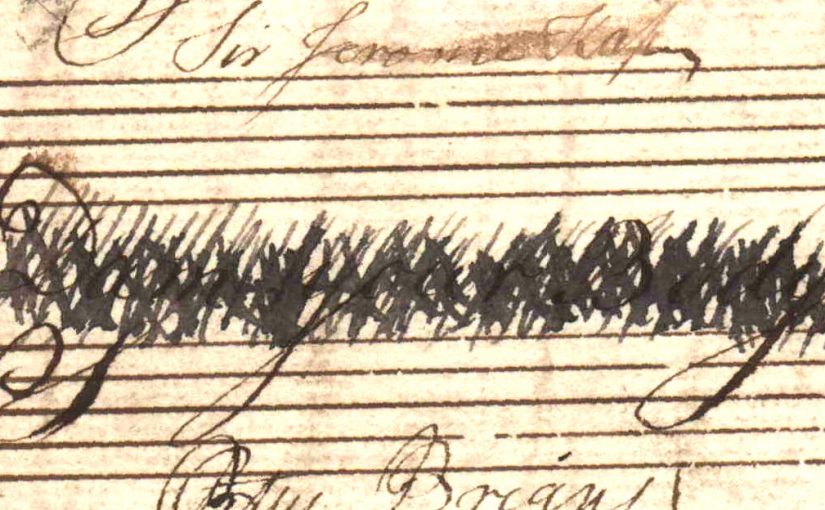
Damn your Body
Queen’s University Belfast, Special Collections, MS4.29 page 185/183/192/f91r is a kind of title page for a 16 page pamphlet which is now bound up in the composite manuscript MS4.29. The pamphlet consists of 16 pages in MS4.29, from page 185/183/192/f91r through to page 200/198/207/f98v, and contains live transcription notations of traditional Irish music, which were written down by Edward Bunting on his collecting trips in the 1790s. This pamphlet seems to have been bound up with all his other loose collecting pamphlets in around 1802-1805, to form the volume which is now QUB SC MS4.29.
Continue reading Damn your Body